Terrestrial Biomes
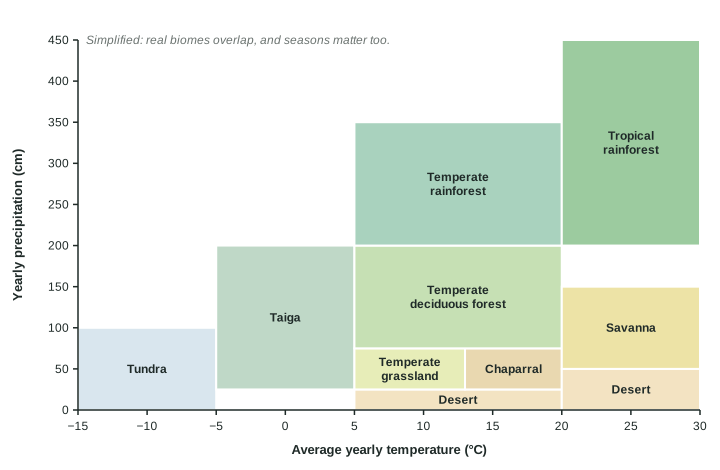
Terrestrial biomes are set mainly by temperature and precipitation.
Part 1 · Hook
Why this matters
Part 2 · Before you start
What this builds on
Part 3 · Prerequisite check
Quick check before you start
1. Which of these is an abiotic factor?
- Yearly rainfall
- A population of rabbits
- A fungus on a log
- A flowering plant
Show the answer
Rainfall is nonliving; the others are living, so biotic.
- Correct: Yearly rainfall:
- A population of rabbits:
- A fungus on a log:
- A flowering plant:
2. A community is best described as...
- all the populations of different species living in one area
- one species in one area
- the nonliving parts of an area
- the place where one species lives
Show the answer
A community is every population living and interacting in one place.
- Correct: all the populations of different species living in one area:
- one species in one area:
- the nonliving parts of an area:
- the place where one species lives:
Part 4 · See it
See it first
Part 5 · Step by step
How it works, step by step
- A place has a certain temperature and precipitation patternonly some kinds of plants can grow there
- The plants that grow set the structure (grass, shrubs, conifers, broadleaf trees)they decide which animals can find food and shelter
- Places with similar climates on different continentsend up with similar-looking biomes, even with different species
Part 6 · Key ideas
Key ideas
- A biome is a large region with a typical climate and typical plants, found on several continents.
- Temperature and precipitation together decide the biome; a climatograph shows both month by month.
- Cold: tundra (with permafrost) and taiga. Temperate: temperate grassland, chaparral, temperate deciduous forest, temperate rainforest. Warm: desert biome, savanna, tropical rainforest.
- Going up a mountain changes biomes in roughly the same order as going toward the poles, because it gets colder.
Part 7 · Misconception
A common mistake
The wrong idea: A savanna is a desert with some grass, so it gets almost no rain.
What actually happens: A savanna gets a fair amount of rain (often 50 to 130 cm a year), but almost all of it falls in a wet season. A long dry season and fires keep trees scattered.
Part 8 · Check yourself
Check yourself
Exam-style questions. Anything you miss goes into your review queue.
1. A biome has long, very cold winters, short summers, and a layer of soil that stays frozen all year. Few trees grow. Which biome is it?
- Taiga
- Tundra
- Temperate grassland
- Chaparral
Show the answer
A soil layer frozen all year is permafrost, which keeps tree roots out. Cold plus permafrost plus few trees is tundra.
- Taiga: Taiga is cold but is a forest of conifers.
- Correct: Tundra: Right: permafrost and almost no trees mark the tundra.
- Temperate grassland: Grasslands have warm summers and no permafrost.
- Chaparral: Chaparral has mild, wet winters and hot, dry summers.
2. Savannas and temperate grasslands both have grasses and few trees. Which fact best tells them apart?
- Savannas get almost no rain, while grasslands get a moderate amount.
- Savannas stay warm through the year; temperate grasslands have cold winters.
- Temperate grasslands have scattered trees, while savannas lack trees.
- Savannas are found mostly at high latitudes near the poles.
Show the answer
Both are grassy, but savannas are tropical: warm all year, with rain falling mostly in one season. Temperate grasslands have hot summers and cold winters.
- Savannas get almost no rain, while grasslands get a moderate amount.: Savannas do get rain, often 50 to 130 cm a year in a wet season; "no rain" is a common error.
- Correct: Savannas stay warm through the year; temperate grasslands have cold winters.: Right: the temperature pattern is the clearest difference.
- Temperate grasslands have scattered trees, while savannas lack trees.: Savannas are the grassland with scattered trees.
- Savannas are found mostly at high latitudes near the poles.: Savannas are tropical, near the equator.
Model or diagram
A climatograph for location X
3. Which statement describes the climatograph for location X?
- Temperatures swing from below freezing in winter to hot in summer.
- It stays warm, and most rain falls in a few wet months.
- It is cool year-round, with steady rain in each month.
- Very little rain falls in any month.
Show the answer
Temperature stays between 24 and 27 °C, while precipitation ranges from 210 mm to 2 mm: a wet season and a dry season.
- Temperatures swing from below freezing in winter to hot in summer.: The temperature line never goes below 24 °C.
- Correct: It stays warm, and most rain falls in a few wet months.: Right: steady warmth with a wet season and a dry season.
- It is cool year-round, with steady rain in each month.: It is warm, and rain varies from 2 to 210 mm a month.
- Very little rain falls in any month.: Several months get more than 150 mm.
4. Which biome best matches location X?
- Tropical rainforest
- Savanna
- Desert biome
- Temperate grassland
Show the answer
Warm all year with a long dry season and a strong wet season is the pattern of a savanna.
- Tropical rainforest: A tropical rainforest is wet in every month; location X has dry months near 0 mm.
- Correct: Savanna: Right: warm all year with a wet and a dry season.
- Desert biome: A desert would be dry all year; location X gets about 1,100 mm.
- Temperate grassland: Temperate grasslands have cold winters; location X stays above 24 °C.
5. What is the total yearly precipitation at location X? Add the 12 monthly values (210, 190, 170, 90, 20, 5, 2, 5, 15, 60, 150, 200) and give the answer in millimeters.
Type a number, then its unit (mm). Scale words (2.5 million) and powers of ten (2.5 × 10^6) are read.
Show the answer
- Answer: 1117 mm
6. The dry months at location X often bring fires. How do the fires help keep this biome grassy?
- Fires kill tree seedlings; grasses regrow from roots.
- Fires add water to the soil, which favors grass over trees.
- Fires cool the soil, so tree roots stop growing.
- Fires kill the grasses but let young trees spread.
Show the answer
Grasses grow back from roots below ground after a fire; young trees are killed, so trees stay scattered.
- Correct: Fires kill tree seedlings; grasses regrow from roots.: Right: fire favors grasses over young trees.
- Fires add water to the soil, which favors grass over trees.: Fire does not add rain.
- Fires cool the soil, so tree roots stop growing.: Fire heats, not cools, the area.
- Fires kill the grasses but let young trees spread.: It is the other way: grasses recover and tree seedlings die.
Data
Climate of four sites
| Site | Average yearly temperature (°C) | Yearly precipitation (cm) | Coldest month (°C) |
|---|---|---|---|
| A | −10 | 20 | −30 |
| B | 27 | 300 | 25 |
| C | 12 | 120 | −3 |
| D | 24 | 15 | 12 |
7. Sites A and D both get little precipitation. What explains why they are different biomes?
- Their temperatures differ: site A is very cold and site D is hot.
- Site A gets more precipitation than site D.
- Site D is closer to the poles than site A.
- They are the same biome, since precipitation decides biomes alone.
Show the answer
Biomes depend on temperature and precipitation together. Both are dry, but A averages −10 °C (tundra) and D 24 °C (desert).
- Correct: Their temperatures differ: site A is very cold and site D is hot.: Right: same dryness, very different temperatures.
- Site A gets more precipitation than site D.: Site A gets 20 cm and site D 15 cm; that small gap does not explain the difference.
- Site D is closer to the poles than site A.: Site D is warm, so it is likely closer to the equator.
- They are the same biome, since precipitation decides biomes alone.: Temperature matters too; a cold dry place and a hot dry place are different biomes.
Part 9 · Summary
Summary
Part 10 · Up next
What comes next
Part 11 · Connections