Aquatic Biomes
Aquatic biomes differ mainly in salinity, depth, light, temperature and dissolved oxygen.
Part 1 · Hook
Why this matters
Part 2 · Before you start
What this builds on
Part 3 · Prerequisite check
Quick check before you start
1. Which is an abiotic factor of a lake?
- Water temperature
- Algae
- Fish
- Bacteria
Show the answer
Temperature is nonliving; the others are living.
- Correct: Water temperature:
- Algae:
- Fish:
- Bacteria:
2. Which two factors mostly decide terrestrial biomes?
- Temperature and precipitation
- Wind and soil color
- Elevation and day length
- Animals and plants
Show the answer
Climate (temperature and precipitation) sets land biomes.
- Correct: Temperature and precipitation:
- Wind and soil color:
- Elevation and day length:
- Animals and plants:
Part 4 · See it
See it first
Part 5 · Step by step
How it works, step by step
- Light fades with depthplants and algae grow only in the sunlit photic zone
- Rivers carry nutrients to coasts and estuariesshallow, sunlit coastal water is very productive
- Warm or still water holds less dissolved oxygenfish and other animals there have less oxygen to use
Part 6 · Key ideas
Key ideas
- Aquatic biomes are sorted by salinity, depth, light, temperature and dissolved oxygen: the freshwater biome (lakes, rivers, wetlands) and marine biomes (estuary, intertidal zone, coral reef, open ocean).
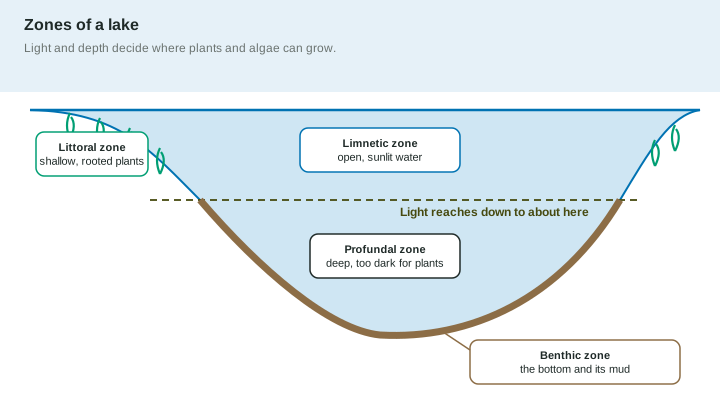
- A lake has a littoral zone (shallow edge), limnetic zone (open sunlit water), profundal zone (deep, dark) and benthic zone (bottom).
- Only the photic zone has enough light for photosynthesis; below it is the aphotic zone.
- Estuaries, salt marshes and mangrove forests grow more life per square meter than almost anywhere on Earth: nutrients plus light plus shelter.
Part 7 · Misconception
A common mistake
The wrong idea: The open ocean grows the most life per square meter because it is so large.
What actually happens: The open ocean grows a lot in total because it is huge, but each square meter grows little: nutrients are scarce in the sunlit surface. Coral reefs, estuaries and wetlands grow far more per square meter.
Part 8 · Check yourself
Check yourself
Exam-style questions. Anything you miss goes into your review queue.
1. Coral reefs grow in clear, warm, shallow water that is low in nutrients. Why does coral need clear, shallow water?
- The algae living inside the coral need sunlight for photosynthesis.
- Coral needs to be near the surface to breathe air.
- Waves carry more food into shallow water.
- Cold, deep water has too much oxygen for coral.
Show the answer
Corals and the algae inside them are a mutualism: the algae make food from light and share it. Murky or deep water blocks the light.
- Correct: The algae living inside the coral need sunlight for photosynthesis.: Right: the coral’s partner algae need light.
- Coral needs to be near the surface to breathe air.: Coral animals take oxygen from water; they do not breathe air.
- Waves carry more food into shallow water.: Coral gets most of its food from its algae, not from waves.
- Cold, deep water has too much oxygen for coral.: Cold water holds more oxygen, but that is not why coral needs shallow water.
Data
Dissolved oxygen and salinity at four sites
| Site | Salinity (ppt) | Water temperature (°C) | Dissolved oxygen (mg/L) |
|---|---|---|---|
| 1: mountain stream | 0 | 8 | 11.5 |
| 2: slow river in a town | 0 | 24 | 6.0 |
| 3: river mouth (estuary) | 15 | 20 | 7.5 |
| 4: open ocean surface | 35 | 18 | 7.8 |
2. Which site is an estuary, based on the data?
- Site 1
- Site 2
- Site 3
- Site 4
Show the answer
An estuary mixes fresh and salt water, so its salinity is between 0 and about 35 ppt. Site 3 has 15 ppt.
- Site 1: Site 1 is fresh water (0 ppt).
- Site 2: Site 2 is fresh water (0 ppt).
- Correct: Site 3: Right: 15 ppt is in between fresh and ocean water.
- Site 4: Site 4 is full seawater (35 ppt).
3. Which relationship between temperature and dissolved oxygen do sites 1 and 2 show?
- Warmer water had less dissolved oxygen.
- Warmer water had more dissolved oxygen.
- Temperature and dissolved oxygen were unrelated.
- Salinity explains the difference in oxygen.
Show the answer
Site 1 at 8 °C had 11.5 mg/L; site 2 at 24 °C had 6.0 mg/L. Both are fresh water, so salinity does not explain it.
- Correct: Warmer water had less dissolved oxygen.: Right: 24 °C with 6.0 mg/L vs 8 °C with 11.5 mg/L.
- Warmer water had more dissolved oxygen.: The warmer site had the lower value.
- Temperature and dissolved oxygen were unrelated.: There is a clear difference that matches the temperatures.
- Salinity explains the difference in oxygen.: Both sites have 0 ppt salinity.
4. How much more dissolved oxygen does the mountain stream (site 1) hold than the slow river (site 2)? Give the answer with its unit.
Type a number, then its unit (mg/L). Scale words (2.5 million) and powers of ten (2.5 × 10^6) are read.
Show the answer
mg/L more at site 1.
- Answer: 5.5 mg/L
Model or diagram
Light with depth in a clear lake
5. About how much of the surface light is left at a depth of 4 m?
- About 70%
- About 30%
- About 9%
- About 55%
Show the answer
The graph reads 30% at 4 m.
- About 70%: 70% is the light lost by 4 m, not the light left.
- Correct: About 30%: Right: the curve passes 30% at 4 m.
- About 9%: 9% is the value at 8 m.
- About 55%: 55% is the value at 2 m.
6. Algae need at least about 1% of surface light to make more food by photosynthesis than they use. Where does the photic zone of this lake end?
- At about 4 m
- At about 8 m
- At about 15 m
- At the lake surface
Show the answer
Light falls to 1.5% at 14 m and 0.8% at 16 m, so the 1% level is near 15 m. Below it is the aphotic zone.
- At about 4 m: At 4 m, 30% of the light is left, well above 1%.
- At about 8 m: At 8 m, 9% is left, still above 1%.
- Correct: At about 15 m: Right: between 14 m (1.5%) and 16 m (0.8%).
- At the lake surface: The surface has all of the light.
7. Rain after a storm washes mud into the lake and makes the water cloudy. How would the graph change?
- Light would fall off faster, so the photic zone would be shallower.
- Light would fall off more slowly, so the photic zone would be deeper.
- The curve would not change, because mud does not block light.
- The surface value would rise above 100%.
Show the answer
Particles absorb and scatter light, so less reaches each depth. The 1% level moves up, and fewer algae and rooted plants can grow deep down.
- Correct: Light would fall off faster, so the photic zone would be shallower.: Right: cloudy water blocks light, so the curve drops faster.
- Light would fall off more slowly, so the photic zone would be deeper.: Mud blocks light; it does not let more through.
- The curve would not change, because mud does not block light.: Suspended particles do block light.
- The surface value would rise above 100%.: The surface value is 100% by definition.
Part 9 · Summary
Summary
Part 10 · Up next
What comes next
Part 11 · Connections