In 1950, about one person in five lived in a city. By 2025, UN DESA counted 45 percent of the world's people in cities (World Urbanization Prospects 2025). This topic asks why cities appear where they do, and why people keep moving to them.
What a city is
A city is a large, dense settlement where most people earn a living from work other than farming: trading, making things, teaching, governing, healing. The word urban means "of the city", and rural means "of the countryside". Urbanization is the process by which a growing share of a population lives in cities. It is a share, not a headcount. If a country's cities grow by one million people while its villages grow by two million, its cities are larger, but the country has not become more urban.
Counting cities is harder than it sounds, because countries draw the line between urban and rural in different ways. In 2025, the UN switched to one method for every country, called the Degree of Urbanisation, which sorts places into cities, towns and rural areas by size and density. Under that method, about 45 percent of people lived in cities in 2025 (UN DESA, World Urbanization Prospects 2025). An older UN series that used each country's own definition gave a higher share. Always read which definition a figure uses.
Where the first cities grew
Cities came after farming. After the First Agricultural Revolution, farmers in a few places grew more food than they ate. That surplus could feed people who did other jobs. Some became potters, builders and traders; some became priests and rulers who collected and stored the grain. They lived close together, and the first cities formed.
At the global scale, the earliest cities cluster in a band across North Africa and Asia: Uruk and Ur in Mesopotamia (Iraq) by the Tigris and Euphrates rivers, cities along the Nile in Egypt, Mohenjo-daro by the Indus in Pakistan, and early cities by the Huang He (Yellow River) in China. Each lay in a fairly dry region crossed by a large river. The river gave water for crops, rich soil from floods and an easy route for boats. Cities also arose on their own in Mesoamerica, where Teotihuacan in central Mexico held a large population by about 500 CE. That independent start shows that cities appear wherever farming makes a surplus, not because the idea spread from one place.
Site and situation
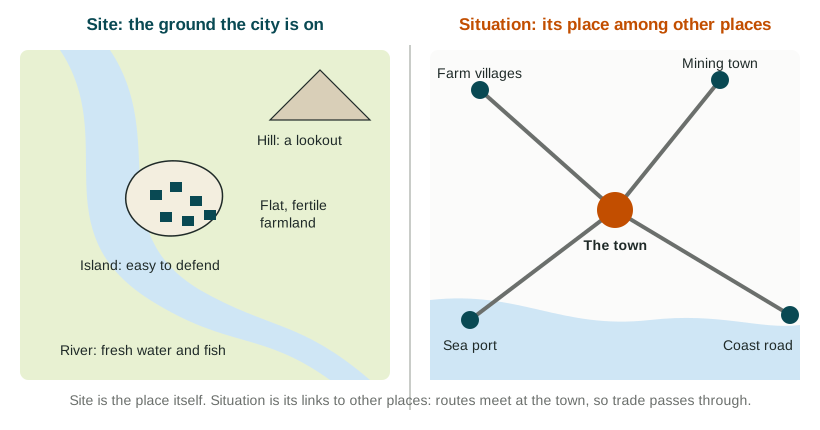
Site is the physical character of the place a city occupies: its landforms, water, soil and climate. Situation is the location of the city relative to other places: the routes, resources, markets and neighbors around it.
| Site | Situation | |
|---|---|---|
| Question it answers | What is the place itself like? | How is the place linked to other places? |
| Example | Paris began on the Île de la Cité, an island in the Seine that was easy to defend. | Singapore sits at the southern end of the Strait of Malacca, on a main sea route between the Indian Ocean and the Pacific. |
| Can it change? | Rarely, unless people reshape the land. | Yes: a new canal, rail line or airport can raise or lower it. |
A site can help at first and cause trouble later. The Aztec capital, Tenochtitlan, was built on an island in Lake Texcoco, which made it easy to defend. Mexico City grew on top of it. As the lake was drained and water was pumped from under the soft old lake bed, parts of the city began to sink, cracking buildings and pipes.
Situation explains why many cities grew so fast. Chicago was a small town in the 1830s. Rail lines from the East and the West met there, beside Lake Michigan's shipping routes, so grain, cattle and lumber from the Midwest passed through it. By 1890, the US census counted over one million people in Chicago. Its site, flat and marshy land by a lake, had not changed. Its situation had.
What drives urbanization
At the national and global scales, several forces push the urban share up, often together.
- Transport. Railroads, ports and highways let a city feed itself from far away and sell what it makes, so it can grow.
- Communication. Telegraph, telephone and internet links let companies run work from a city, and let migrants hear about city jobs.
- Population growth. When rural families grow faster than the farmland can support, young people leave for cities.
- Migration. Rural-to-urban migration is the largest single source of new city dwellers in many countries; push factors in villages and pull factors in cities both matter.
- Economic development. As factories and offices grow and farm machines need fewer hands, jobs move to cities.
- Government policy. Brazil built Brasília as a new inland capital, opened in 1960, to pull people and money away from the coast. Starting in the 1980s, China slowly loosened rules that had made it hard for rural people to move to cities, and its cities grew fast.
Urbanization is a model of change, not a law. It can slow or even reverse at the local scale: a city whose factories close may lose people for decades, even while its country keeps urbanizing.