Human geography asks "where?" and then "why there?". To answer, geographers use a small set of ideas about location, connection and distance. They come up in every unit of the course.
Absolute and relative location
Absolute location is an exact position on the globe, given by two numbers. Latitude measures degrees north or south of the equator; longitude measures degrees east or west of the prime meridian, a line through Greenwich in London. Cairo, Egypt, lies at about 30 degrees north and 31 degrees east. A phone's satellite navigation finds absolute location.
Relative location describes a place by what it is near: "Kansas City is near the center of the United States, where the Kansas River meets the Missouri River." Relative location changes when the things around a place change, such as a new highway or a closed port.
Site and situation
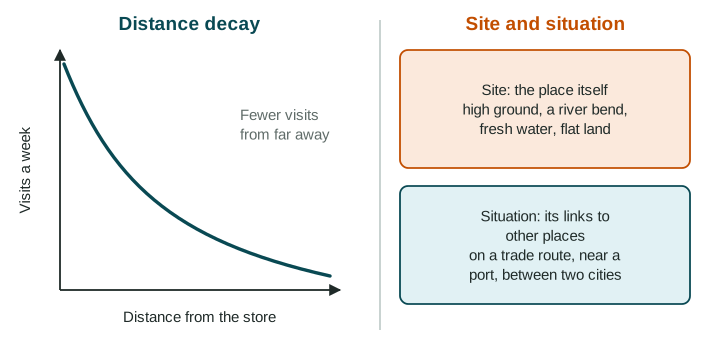
Site is the physical character of the place itself: its landforms, water, soil and climate. Situation is the place's location relative to other places: the routes, neighbors and resources around it. Together they explain why a place grew.
| City | Site (the spot itself) | Situation (its links) |
|---|---|---|
| Singapore | A small, flat island with a deep, sheltered harbor | Beside the Strait of Malacca, on the sea lane between the Indian Ocean and the South China Sea |
| Chicago | Flat land on Lake Michigan where the Chicago River enters it | A hub of rail lines and lake shipping between the eastern United States and the West |
| Paris | Islands in the Seine River that were easy to defend and to cross | At the center of farm regions and roads in northern France |
A common slip on the exam is mixing them up. If the description mentions other places or routes, it is situation.
Place and space
Place is a location plus the meaning people give it. New Orleans is known for its music, food and festivals such as Mardi Gras; that character is its sense of place. Space is the area between and around places and how things are arranged across it. The arrangement is a spatial pattern: towns in Egypt form a long line along the Nile; farmhouses in Iowa are dispersed; shops cluster downtown.
Flows, distance decay and time-space compression
Flows are movements between places: goods on ships passing Singapore, money that workers in Dubai send to their families in Kerala, India, news and ideas on the internet.
Distance decay is the idea that contact between places falls as the distance between them grows. Most fans at a city stadium live nearby; far fewer come from 80 km away. People shop, visit and marry nearby more than far away.
Time-space compression is the way faster transport and communication shrink the time needed to connect places. In 1840 a letter took about two weeks to cross the Atlantic by steamship; a video call between London and New York now connects in seconds (2026). As travel time falls, places feel closer and distance decay weakens: a high-speed train that cuts the Lyon to Paris trip to about two hours makes day trips common.