People live with the physical environment: land, water, climate, soil, plants and animals. The environment shapes what people can do, and people reshape the environment. Human geographers study both directions of that relationship.
Natural resources and land use
A natural resource is something from nature that people use: water, soil, fish, forests, minerals, oil, sunlight, wind. Renewable resources can replace themselves (sunlight, wind, fish, river water), as long as people do not use them faster than they renew. Nonrenewable resources, such as oil, coal and natural gas, took millions of years to form and are used up once burned.
Land use is how people use an area of land: as forest, farm fields, homes, roads, factories or parks. When a stretch of rainforest near Manaus, Brazil, is cleared for a road and housing, its land use changes, and so does the environment around it.
Sustainability
Sustainability means using land and resources so that people now meet their needs without harming the ability of future people to meet theirs. Two cases show what happens when use is not sustainable:
- The Aral Sea, on the border of Kazakhstan and Uzbekistan, was once one of the largest lakes in the world. From the 1960s, Soviet planners diverted its two feeding rivers to water new cotton fields. The sea shrank and split, fishing towns were stranded, and salty dust blew from the dry seabed. Since 2005, a dam has helped the northern part refill partly.
- Newfoundland cod. Heavy fishing off Newfoundland, Canada, caused the cod stock to collapse, and Canada banned commercial cod fishing in 1992. Fish are renewable, but only when catches stay below what the stock can replace.
Sustainable choices also exist. On steep hillsides from the Philippines to Peru, farmers cut slopes into flat, walled steps that slow rainwater and keep soil from washing away, so the same slopes can be farmed for generations.
From determinism to possibilism
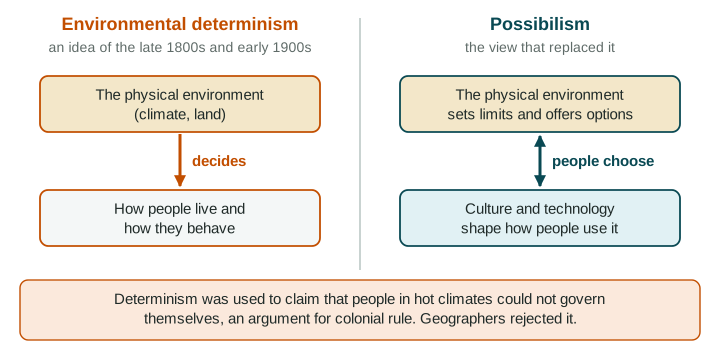
In the late 1800s and early 1900s, some geographers held environmental determinism: the idea that the physical environment, especially climate, decides how people live and behave. Writers of that time claimed that hot climates made people less hardworking and cool climates made them more inventive. These claims were used to justify European powers ruling peoples in Africa, Asia and the Americas, and to rank peoples as better or worse.
Geographers rejected determinism. Evidence showed that people in every climate build complex societies, and that the same environment is used in very different ways by different groups and at different times. The French geographer Paul Vidal de la Blache and others argued for possibilism: the environment sets limits and offers options, and people choose among them using their culture and technology.
| Environmental determinism | Possibilism | |
|---|---|---|
| Main claim | The environment decides how people live. | The environment sets limits; people choose. |
| Role of people | Passive: shaped by climate and land | Active: adapt, reshape, decide |
| Example | "Hot climates make people lazy" (a rejected claim) | The Dutch took land from the sea with dikes and pumps. |
| Status | Rejected; used to justify unequal rule | Widely used, though limits still matter |
Possibilism has limits of its own. It can make human choice sound unlimited, when costs, power and the environment still constrain what people can do. Las Vegas, Nevada, shows both sides: a large city grew in a desert thanks to Hoover Dam and the Colorado River, but it now depends on a river shared with millions of others in a long-running drought.