
Think about the last meal you ate. Who cooked it, what was in it, how you ate it and who you ate it with were all shaped by the people around you. Geographers call those shared ways of living culture, and they study where cultures are found, why they are found there and how they change the land.
What culture is
Culture is the shared practices, beliefs, objects and behaviors that a group learns and passes on. Each separate part of a culture is a culture trait: a food, a greeting, a holiday, a song, a style of house or a way of using land. A group's culture is the whole set of its traits.
Culture is learned, not inherited. A child born to parents from Japan and raised from birth by a family in São Paulo, Brazil, grows up speaking Portuguese and cooking Brazilian food. Nothing in her body decided that; the people around her taught it.
Some traits are things you can touch, such as clothing, tools and buildings. Others you cannot touch, such as beliefs, values and customs. Both kinds count as culture.
Culture traits on the land
Geography cares most about the traits you can see on a map or in a landscape. Three examples:
- Food. In Indonesia, at the local (subnational) scale, pig farms are common on the island of Bali, where most people are Hindu, and rare on nearby Java, where most people are Muslim and follow food rules that forbid pork. A religious trait changes what farmers raise.
- Architecture. At Taos Pueblo in New Mexico, people have lived for centuries in buildings of adobe: bricks of earth and straw dried in the sun. The material is local, and the method is taught from one generation to the next.
- Land use. How a group divides fields, where it builds places of worship and what it grows all leave a pattern on the ground that you can map.
The adobe example links back to Unit 1. The dry environment did not force people to build with earth; it offered a good option, and people chose it and kept it. That is possibilism, not environmental determinism.
Folk culture and popular culture
Many textbooks sort culture into two broad kinds. The comparison helps you describe a trait more precisely.
| Folk culture | Popular culture | |
|---|---|---|
| Who shares it | A small, close group, often rural | Large, mixed groups in many places |
| How it is passed on | Family, elders, community, word of mouth | Media, advertising, business, the internet |
| How fast it changes | Slowly, over generations | Quickly, often within months |
| Pattern on a map | Differs a lot from place to place | Looks much the same from place to place |
| Example | Amish horse-and-buggy travel and barn raisings in Lancaster County, Pennsylvania | Chain restaurants and streamed hit songs found across the United States |
The same county can hold both. A few miles from Amish farms, shopping centers in Lancaster County hold the same chain stores you would find in Texas or Ohio. Scale matters here: at the national scale popular culture looks dominant, but at the local scale a folk tradition can still shape daily life.
Two ways to look at another culture
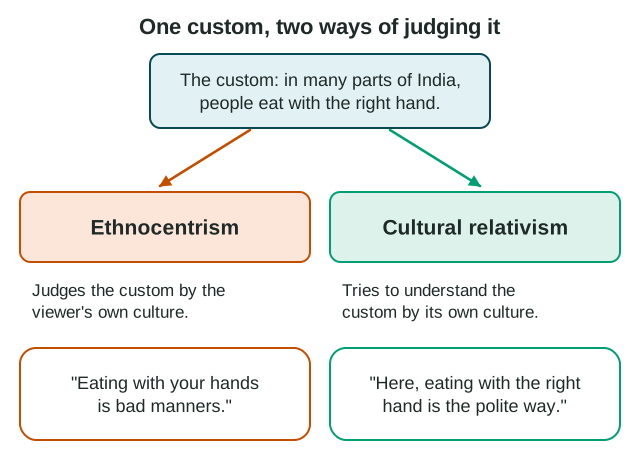
Ethnocentrism is judging another culture by the standards of your own, usually treating your own ways as normal or correct. A student who sees fried crickets sold as a snack in Bangkok, Thailand, and calls them "gross" instead of "food" is being ethnocentric.
Cultural relativism is trying to understand a practice by the standards of the culture it belongs to. In many parts of India, people eat with the right hand. A relativist asks what the custom means there, and learns that it is the polite way to eat, rather than calling it bad manners.
Relativism does not mean you must adopt a custom or agree with every practice. It means you explain a trait in its own setting before you judge it. That is the habit geographers use, and the reason this course never ranks cultures as better or worse.
Worked example: name the attitude. A visitor to a dinner in Seoul, South Korea, notices that everyone waits for the grandmother to start eating.
- The visitor says, "That is a waste of time; at home we just eat." The visitor judges the custom by home standards: ethnocentrism.
- The visitor asks why and learns it shows respect for older people, then waits too. The visitor understands the custom by its own standards: cultural relativism.
The method: find the judgment, then ask whose standards it uses.
Why it matters on the exam
Free-response questions often ask you to explain how a culture trait shapes a place. A strong answer names the trait, names a real place and its scale, and gives the link: "On Bali, at the local (subnational) scale, most people are Hindu, so pork is eaten and pig farms are common." Avoid words that rank cultures, such as calling a group "advanced"; the readers want explanation, not judgment.