Your phone can play a song recorded in Seoul, show a video filmed in Lagos and translate a message from Spanish in seconds. That speed is new. The causes of diffusion in Topic 3.5 were ships, caravans and empires; the causes today are networks.
Globalization and the speed of culture
Globalization is the growing connection of places around the world through trade, travel, media and the internet. Goods, money, people and ideas now move faster and farther than ever. This builds on time-space compression from Unit 1: fast transport and communication shrink the effect of distance, so a trait can jump between continents in days.
Culture spreads through several channels at once:
- Media and technology: streaming services, social media and phones carry songs, shows and slang worldwide.
- Economics: global companies open the same stores and sell the same products in many countries.
- Politics: governments make laws that promote or protect a culture.
- Social ties: migrants keep in touch with home by video call and online shows, so they carry culture both ways.
- Growing cities: large cities such as Lagos, Nigeria, mix people from many groups, with shops and media that spread popular culture to newcomers.
Culture is made by people, not fixed by nature, so it changes whenever these forces change daily life.
Two pulls: convergence and divergence
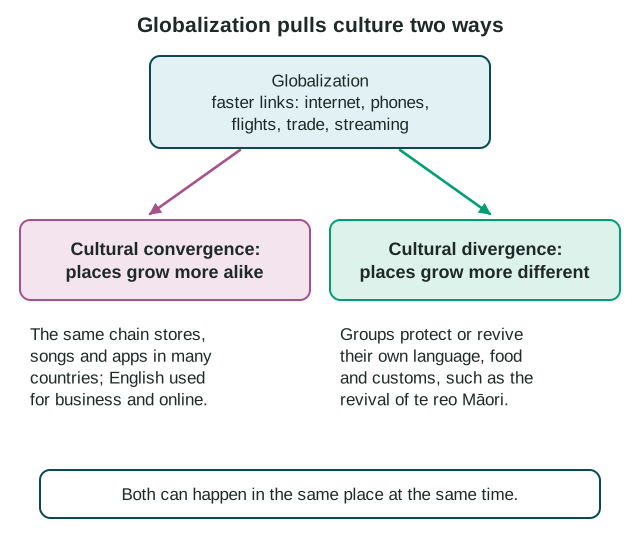
Cultural convergence is places growing more alike. A traveler finds the same coffee chain, phone stores and hit songs in malls in Dubai, United Arab Emirates, and Toronto, Canada. English has become a shared language of international business, science and much of the internet, helped by the earlier spread of British and United States influence.
Cultural divergence is places growing or staying different. Under a French law passed in 1994, radio stations in France must play a large share of songs in French. Groups also use the same new tools that drive convergence, such as radio, apps and streaming, to keep their own culture alive.
| Cultural convergence | Cultural divergence | |
|---|---|---|
| Places become | More alike | More distinct |
| Driven by | Global brands, shared media, a few large languages | Pride in local culture, protective laws, revival efforts |
| Example | The same chain stores in Dubai and Toronto | France's radio rule for French songs; the revival of te reo Māori |
Threatened languages, and revivals
Ethnologue's 29th edition (2026) lists about 7,170 living languages, and many have few young speakers. When young people need a widely used language for school, jobs and online media, they speak their own language less and pass less of it to their children.
New Zealand shows both the threat and a response. Te reo Māori is the language of the Māori, the Indigenous people of New Zealand. For much of the 1900s, schools taught in English, and many Māori children were punished for speaking te reo; by the 1970s, few young Māori spoke it fluently. Māori Language Week began in 1975. In 1982, families opened the first kōhanga reo, "language nests" where young children spend the day speaking only te reo. The Māori Language Act of 1987 made te reo an official language, and a Māori television channel began broadcasting in 2004. At the national scale, the revival is cultural divergence: New Zealand keeps a language found nowhere else.
Scale and limits
Convergence and divergence can happen in one place at once: a city can fill with global chain stores while its young people revive a local language. National data can hide local change, so a falling national line for a language does not mean it is fading in every village. When you explain a change, name the force (media, technology, politics, economics or social ties), the place, the scale and the link.