
Diffusion brings cultures into contact: through migration, trade, colonial rule and the internet. Contact changes people. Some add new traits, some lose old ones, some create something new, and some live beside each other without merging. AP® Human Geography names these four effects, and readers often see them mixed up.
Four effects of diffusion
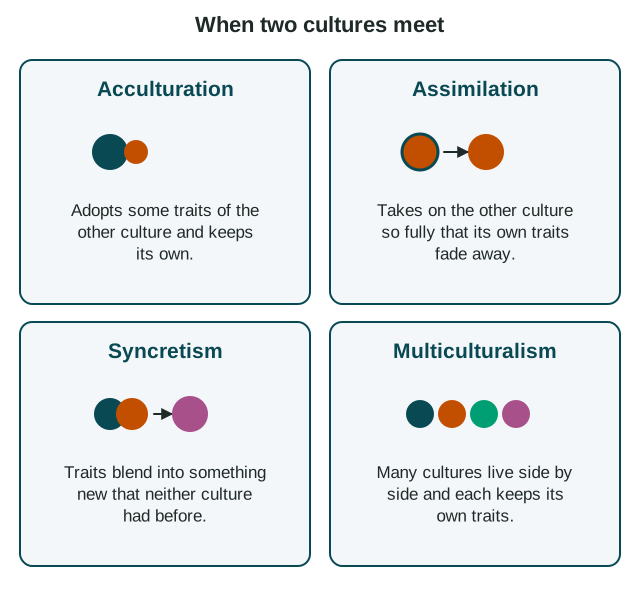
- Acculturation is a group adopting some traits of another culture while keeping its own. A woman who moved from Viet Nam to Houston, Texas, learns English for her job and cheers for the local football team, but she speaks Vietnamese at home and celebrates Tết, the Lunar New Year.
- Assimilation is a group taking on another culture so fully that its own traits fade away. Many great-grandchildren of Norwegian immigrants to rural Minnesota speak only English and keep few Norwegian customs beyond a holiday dish.
- Syncretism is traits from two cultures blending into a new form that neither had before. In Mexico, the Day of the Dead blends Indigenous traditions of honoring the dead with the Catholic days of All Saints and All Souls. In Cuba, Santería blends Yoruba religious traditions, brought by enslaved West Africans, with Catholic saints.
- Multiculturalism is many cultures living side by side in one society, each keeping its own traits. Canada made multiculturalism an official policy in 1971, and in Toronto groups keep their own languages, festivals and neighborhoods, such as Chinatown and Little Portugal.
Telling them apart
Ask one question: what happened to the original culture?
| Effect | The original culture | Picture it as | Example |
|---|---|---|---|
| Acculturation | Stays, with new traits added | Two coats, worn one over the other | A newcomer in Houston who keeps Vietnamese at home |
| Assimilation | Fades away | A melting pot | Norwegian immigrants' great-grandchildren in Minnesota |
| Syncretism | Blends into something new | Two colors mixed into a third | The Day of the Dead; Santería |
| Multiculturalism | Stays, beside other cultures | A salad bowl | Toronto, Canada |
Acculturation and multiculturalism both keep the original culture, but at different scales: acculturation is about what one person or group does, while multiculturalism describes a whole society or policy. Syncretism is close to creolization from Topic 3.5; syncretism is the term used most for religion and festivals.
Chosen or forced
These effects can be chosen or pressed on people. Many migrants choose to assimilate over generations. Other times, governments have forced it. From the 1880s until the last one closed in 1996, Canada's government ran residential schools that took many Indigenous children from their families and punished them for speaking their own languages. Canada's Truth and Reconciliation Commission reported in 2015 on the deep harm they caused. Forced assimilation is one reason so many Indigenous languages are threatened, and one reason for the revivals you met in Topic 3.6.
Scale and evidence
Name the scale. A national policy, such as Canada's multiculturalism, shows up at the local scale in distinct neighborhoods. Data about one family can show acculturation or assimilation across generations, but one family cannot prove what a whole group does; for that you need census data or a large study.
Worked example: compare two effects. "Compare assimilation and acculturation."
- Side one: in assimilation, the old culture fades, as with Norwegian immigrants' great-grandchildren in Minnesota who speak only English.
- Side two: in acculturation, the old culture stays beside the new, as with a newcomer in Houston who learns English but keeps Vietnamese at home.
- The comparison: both involve adopting a new culture, whereas only assimilation loses the old one.
Defining both terms without saying how they differ earns no point; a compare must speak of both sides.