Look at a world map and you see the world divided into countries, each in its own color. Political geography studies how people divide up and control space. It starts with two words that everyday English often mixes up: state and nation.
States: the basic political units
A state is what most people call a country. To count as a state, a place needs four things: a permanent population, a defined territory (an area of land it controls), a government that runs that territory, and recognition by other states. France, Brazil and Viet Nam are states. The United Nations (UN) has 193 member states, plus two observer states, the Holy See and the State of Palestine (UN, 2026). You will see other counts too, because states do not all agree about which places to recognize. Taiwan and Kosovo, for example, run their own affairs but are not UN members, and only some states recognize them.
States are the main actors in world politics. They make laws, collect taxes, print money, raise armies and sign agreements with each other. That is why geographers call the state the basic unit of the political map.
Nations: peoples with a shared culture
A nation is a group of people who share a culture, such as a language, a history, a religion or customs, and who see themselves as one people. Many nations also feel tied to a homeland. A nation is about people and identity; a state is about government and territory. In the United States, people often say "nation" when they mean "country", so be careful: on the exam, the two words mean different things.
Four ways nations and states fit together
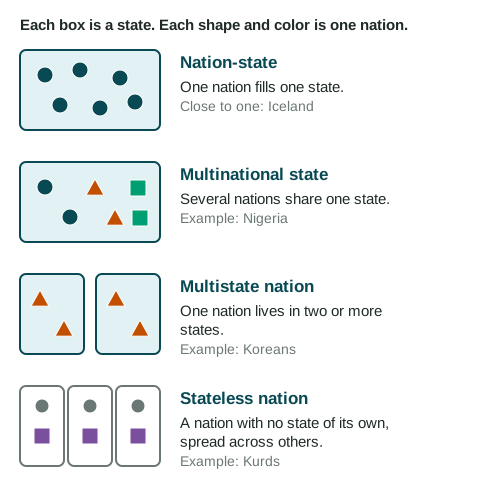
State borders rarely match where nations live, so nations and states combine in four main ways.
| Term | What it means | Example, with its scale |
|---|---|---|
| Nation-state | One nation fills one state. | Iceland, at the national scale: most people share the Icelandic language and history. |
| Multinational state | One state holds two or more nations. | Nigeria (Hausa, Yoruba, Igbo and hundreds of other groups); Belgium (Dutch-speaking Flemish and French-speaking Walloons). |
| Multistate nation | One nation lives in two or more states. | Koreans, at the regional scale: one nation in North Korea and South Korea. |
| Stateless nation | A nation with no independent state of its own. | The Kurds, at the regional scale: their homeland spans parts of Türkiye, Iraq, Iran and Syria. |
A perfect nation-state is rare. Even Iceland and Japan, two common examples, have minorities and people born abroad. So say a state is "close to" a nation-state. Most states in the world are multinational. A nation can also fit two terms at once: the Kurds live in four states, so they are a multistate nation, and they have no state of their own, so they are also a stateless nation. The Sámi of northern Norway, Sweden, Finland and Russia are another nation spread across several states.
Autonomous and semiautonomous regions
Some nations do not have a state but do have powers inside one. An autonomous region is a part of a state that governs many of its own affairs, such as schools, language and local taxes, while the national government keeps powers such as defense and foreign policy. A region with fewer powers is often called semiautonomous.
- Greenland has its own parliament and has run most of its own affairs since 2009, but it is part of the Kingdom of Denmark, which handles its defense and foreign policy.
- The Kurdistan Region of Iraq has its own parliament and security forces under Iraq's 2005 constitution, while it stays part of Iraq.
- Native American reservations in the United States, such as the Navajo Nation in Arizona, New Mexico and Utah, have their own governments, courts and police, inside the United States. This is the local scale: one area inside one state.
Why it matters
When the map of states and the map of nations do not match, tension can follow. A nation without a state may want one; a state with several nations has to hold them together. The rest of this unit follows those tensions: how states gained their territory, how borders are drawn, how power is shared inside a state, and why some states break apart.