"Scale" is one of the most used words in human geography, and one of the most confused. It has two meanings. One is about how a map is drawn. The other is about the data, and that is the one the AP® Human Geography exam scores again and again.
Two meanings of scale
| Map scale | Scale of analysis | |
|---|---|---|
| What it is | How much the map shrinks the ground | The size of the unit the data describe |
| How it is written | A ratio (1:50,000) or a scale bar | Global, regional, national or local |
| Question it answers | How far is it on the ground? | Which places are being compared? |
Map scale
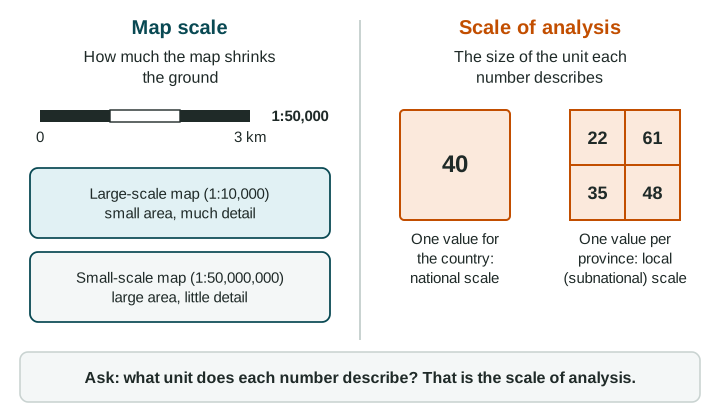
Map scale compares a distance on a map with the same distance on the ground. A scale of 1:50,000 means 1 cm on the map stands for 50,000 cm on the ground. Since 100,000 cm make 1 km, that is 0.5 km. So two villages 4 cm apart on the map are 2 km apart on the ground.
The names are the opposite of what most students expect. A large-scale map has a large fraction, such as 1:5,000, so things look big and the map can only fit a small area, like a neighborhood. A small-scale map has a tiny fraction, such as 1:50,000,000, so things look small and the map can fit a continent or the world.
Scale of analysis
The scale of analysis is the size of the unit that each piece of data describes. There are four:
- Global scale: the whole world, comparing places across it.
- Regional scale: a part of the world made of several countries, such as South Asia or Latin America. (People also say "region" for part of a country, so say which you mean.)
- National scale: one country as a whole, with one value for each country.
- Local scale: a part of a country, such as a province, a state, a city or a neighborhood. Data for parts of a country are also called subnational.
The trap: the map's size is not the data's scale
In 2025, readers of the AP® Human Geography exam reported that only about 38% of students correctly named the scale of a map whose data were for parts of one country. Most wrote "national", because the map showed a whole country. But each value described a part of the country, so the data were subnational: the local scale.
The rule: ask what unit each number describes. A world map with one color for each country shows national data. A map of one country shaded by province shows local (subnational) data. The size of the area on the map does not decide the scale of analysis.
Same place, different stories
Egypt shows why scale matters. At the national scale, Egypt has a moderate number of people for each square kilometer. At the local scale, the picture changes: almost everyone lives within a few kilometers of the Nile River or in its delta, which is very crowded, while the desert to the east and west is nearly empty. The national number is an average of two very different places and describes neither.
The same thing happens with any national average. A country where 60% of homes have internet access may have provinces at 85% and others at 35%. A government deciding where to build should use the province data, because its decision is about provinces.
How to name the scale in an answer
When a question asks for the scale of analysis, name it and give the unit: "local (subnational), because each value is for a province." When you describe a pattern, say at what scale it holds: "At the national scale, Egypt looks moderately crowded; at the local scale, people are packed along the Nile."