
Half of your AP® Human Geography exam score comes from three free-response questions (FRQs). You type the answers, and trained readers score them. The good news: the scoring is predictable. Each part asks for one thing, and if you do that thing you earn the point.
How the free-response section works
In May 2027 the free-response section lasts 75 minutes and has three questions, each worth 7 points:
- Question 1 has no stimulus: you answer from what you know, with your own real examples.
- Question 2 has one stimulus: a map, an image or a set of data, such as a table or chart.
- Question 3 has two stimuli (maps, images or data), often to compare.
Every question has seven parts, A to G. Each part is worth exactly 1 point. Readers use a rubric, a scoring guide with one line for each point, and they check your answer against that line only. Writing more does not earn more; doing the right thing does. No calculator is allowed, and none is needed.
The task verbs
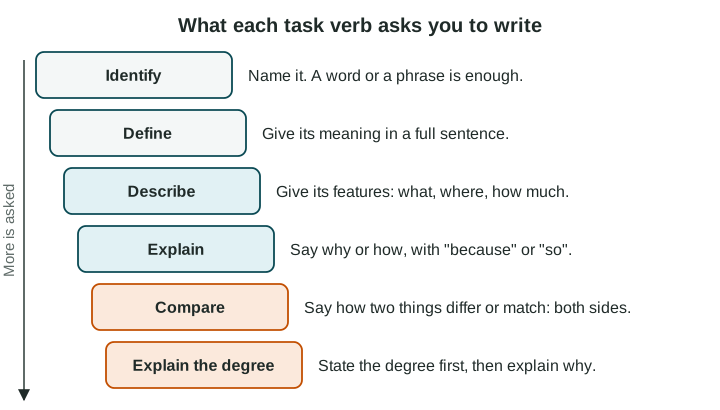
A task verb is the word that tells you what to do. Read it first and underline it.
| Verb | What earns the point | Example answer |
|---|---|---|
| Identify | Name it. A word or phrase is enough. | "Job opportunities." |
| Define | Give its meaning in a full sentence. | "A trend is a change in data over time." |
| Describe | Give its features: what, where, how much. | "Most farms are along the river in the south; few are in the northern hills." |
| Explain | Say how or why, with every link: cause, then because or so, then effect. | "The capital has more paid jobs, so people move there to earn more." |
| Compare | Say how two things differ or match, speaking of both. | "The north is dry and lightly settled, whereas the south is wet and crowded." |
| Explain the degree | State the degree first (high, moderate, low), then explain. | "To a high degree: province data show where clinics are fewest, so..." |
Where students lose points
Readers' reports from recent exams name the same slips every year:
- Naming when the verb says explain or describe. "Jobs" identifies a reason; it does not explain one.
- A chain with a missing link. Readers want each step: a new highway, so shorter drives to the edge of town, so more people shop there.
- One side of a comparison. If two places are named, say something about both.
- No degree. "Explain the degree" needs the degree stated, first.
- Restating the question. Copying the prompt back earns nothing.
- No place, no scale. "In some countries" is too vague. Name a real place and, when it helps, the scale of analysis.
A routine for every part
- Underline the task verb and circle what it is about.
- If there is a stimulus, find the evidence in it: a place, a value, a trend.
- Write one or two sentences that do exactly what the verb asks. For explain, use "because" or "so".
- Check: did I name a place? Did I answer at the scale asked?