Look out a plane window over Iowa and you see a patchwork of corn fields, each worked with tractors, seed and fertilizer. Fly over the grasslands of Mongolia and you might see a few white tents and a herd of sheep spread over miles. Both are agriculture: the raising of crops and animals on purpose for food, fiber and other goods. They differ in how much people put into each piece of land, and in what the climate allows.
Intensive and extensive agriculture
The things a farmer puts into land are called inputs: labor (people's work), money, machines, seed, fertilizer and water. Geographers sort farming by how many inputs go into each hectare (a hectare is a square 100 meters on a side, about two and a half acres).
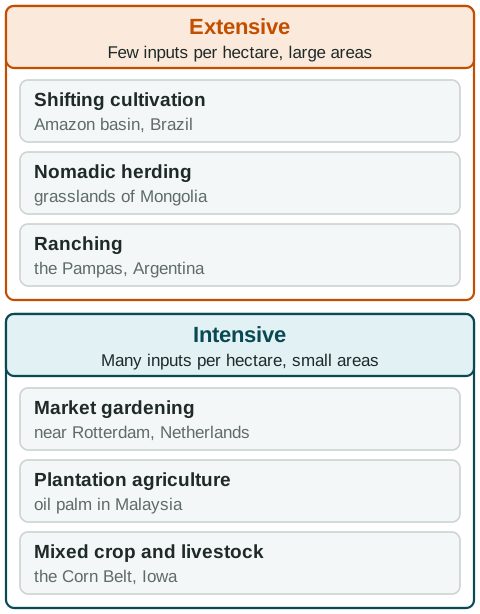
- Intensive agriculture uses many inputs on each hectare, usually on small plots, to get a large output from each hectare.
- Extensive agriculture uses few inputs on each hectare, over large areas. Output per hectare is low, but the area is huge.
A common mistake is to think "intensive" means a big farm. A cattle ranch of 2,000 hectares is extensive; a greenhouse of 2 hectares is intensive. Measure inputs per hectare, not the size of the farm.
| Extensive | Intensive | |
|---|---|---|
| Inputs per hectare | Few | Many |
| Area used | Large | Small to medium |
| Kinds | Shifting cultivation, nomadic herding, ranching | Market gardening, plantation agriculture, mixed crop and livestock farming |
| Example place | Amazon basin, Brazil; Mongolia; the Pampas, Argentina | Westland, near Rotterdam, Netherlands; Malaysia; Iowa, United States |
The extensive kinds
Shifting cultivation (also called slash and burn or swidden farming) is found in tropical rainforests, such as the Amazon basin in Brazil and the island of Borneo. Farmers clear a small plot, burn the cut plants so the ash adds nutrients to the soil, and grow crops for a few years. When the thin soil wears out, they move to a new plot and let the old one rest for many years so the forest grows back. With few people and long rests, the system can last for generations. When more people must live from the same forest, the rest periods shrink and harvests fall.
Nomadic herding (also called pastoral nomadism) means moving herds of animals, such as goats, sheep, camels or yaks, to fresh grass and water with the seasons. It is found across a dry belt at the regional and global scale, from the Sahel of West Africa through Southwest Asia to Mongolia. The land is too dry for most crops, but grazing animals can turn its grass into milk, meat, wool and leather.
Ranching is raising livestock, usually cattle or sheep, that graze over large areas of fixed, often fenced land. It is common on the Pampas of Argentina, in the Great Plains of the United States and in the outback of Australia. Unlike herders, ranchers stay in one place, and they usually sell their animals to distant buyers.
The intensive kinds
Market gardening (also called truck farming) grows fruits, vegetables and flowers for nearby city markets. These products spoil quickly, so the farms sit close to the people who buy them. In Westland, near Rotterdam in the Netherlands, greenhouses grow tomatoes, peppers and flowers under glass with controlled heat and water.
Plantation agriculture grows one crop on a large estate, usually in tropical places, for sale far away. Oil palm in Malaysia and Indonesia, bananas in Ecuador and tea in Sri Lanka are examples. Many plantation regions began under colonial rule, and in the Americas the early sugar plantations of the Caribbean and Brazil used the forced labor of enslaved Africans. Today plantations employ many workers on each hectare.
Mixed crop and livestock farming raises crops and animals together on one farm, and much of the crop feeds the animals. In the Corn Belt of Iowa, corn and soybeans feed hogs and cattle. This kind of farm is common in the US Midwest and Western Europe.
Climate shapes farming
Climate sets what grows easily in a place. In a tropical climate, such as Malaysia's, heat and rain all year suit rainforest plots and plantation crops. In a dry climate, such as Mongolia's, herding makes more sense than crops. Mediterranean agriculture grows in places with hot, dry summers and mild, rainy winters: southern Spain, Italy, Greece, central Chile, the Western Cape of South Africa and coastal California. Farmers there grow crops that survive summer drought, such as olives, grapes and citrus, often with wheat in the wet winter.
Climate does not decide everything. Irrigation, the supply of water to crops by canals, pipes or sprinklers, lets people farm where rain alone would not allow it. In the Imperial Valley of California, a desert, canals from the Colorado River water lettuce and other vegetables. This is possibilism in action: the environment offers limits, and people choose how to work with them.