A banana in a lunchbox in Ohio may have been growing on a farm in Ecuador two or three weeks before. It was cut green, washed, boxed, trucked to a port, shipped in a cold hold, ripened with gas in a warehouse and trucked again to a store. Farming today is tied together across the world. That has benefits, and it creates risks for places that depend on a single crop.
Global supply chains
A global supply chain is the network of steps, places and companies that a product passes through from the farm to the consumer, across countries. It builds on the commodity chain from the last topic, but at the global scale.
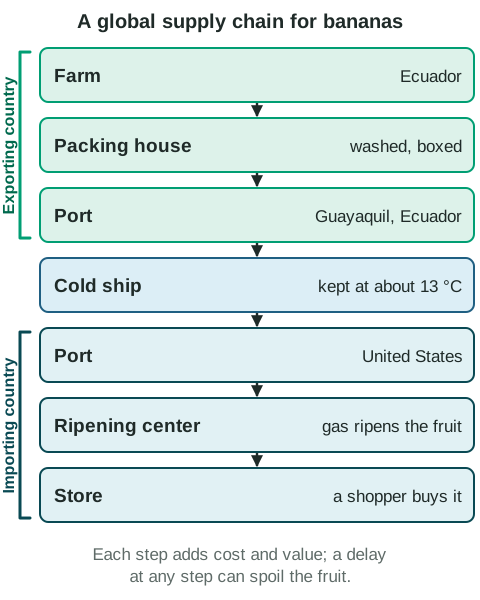
A supply chain is much more than transport. Growing, packing, storing, processing, ripening, marketing and selling are all steps, and each adds value and cost. Exam readers have marked down answers that treated a supply chain as only ships and trucks.
Refrigerated shipping containers, fast ships and planes and cheap fuel make long chains possible. They shrink the effect of distance: a form of time-space compression. Brazil, for example, exports more soybeans than any other country, and China is the largest buyer, using much of them to feed pigs and poultry (USDA, 2024). Chile ships grapes to North America during the northern winter, and Kenya flies cut flowers to Europe overnight.
Long chains are also fragile. A port strike, a storm, a war or a disease outbreak at one step can delay food, spoil it or raise its price for people far away.
Commodity dependence
A commodity is a raw good sold in bulk, such as coffee, cocoa, cotton or wheat. Commodity dependence means relying on one or a few raw exports for most of a country's export earnings. UN Trade and Development (UNCTAD) calls a country commodity dependent when commodities make up more than 60% of its merchandise export earnings; in its 2025 report, 95 of 143 developing countries met that test in 2021 to 2023 (UNCTAD, State of Commodity Dependence 2025). Many of those countries depend on minerals or oil, but some depend mainly on farm goods such as coffee, cocoa or cotton.
Why is it risky?
- Prices swing. World prices for crops rise and fall with weather, harvests elsewhere and demand. A country that sells mostly one crop sees its income rise and fall with them.
- Little value stays at home. Raw beans earn less than roasted, packaged coffee. When processing happens in importing countries, most of the final price is earned there.
- Hard to switch. Coffee and cocoa trees take years to start producing, so farmers cannot quickly change crops.
For example, cocoa grown mostly on small family farms is a leading export of Côte d'Ivoire, while most chocolate is made and sold far away. When the cocoa price falls, the effect reaches every scale: national export earnings and government revenue drop, and at the local scale farm families earn less. Countries try to reduce dependence by processing crops at home (adding value) and by diversifying into other products.
What shapes food distribution
The world grows enough food to feed everyone, yet hunger remains. Who gets food depends on more than how much is grown:
| Factor | How it shapes distribution | Example |
|---|---|---|
| Politics and conflict | War can block ports and roads | After Russia's full-scale invasion of Ukraine in February 2022, Black Sea grain shipments were disrupted and world wheat prices rose; a deal brokered by the UN and Türkiye let ships sail from July 2022 to July 2023 |
| Trade rules and government payments | Taxes on imports and payments to farmers change prices and who can sell where | Payments to farmers in the United States and the European Union can lower world prices for some crops |
| Roads, ports and storage | Poor roads and storage let food rot before it reaches buyers | Rural areas far from paved roads in many countries |
| Income | People who cannot afford food go hungry even where food is sold | Low-income households when prices rise |