In 1935 the United States had about 6.8 million farms (USDA). The 2022 Census of Agriculture counted about 1.9 million, with an average size of 463 acres. The country grows far more food than it did, on fewer, larger farms linked to large companies. This topic explains how farming is organized and why it has been changing.
From family farms to large operations
In many more developed countries, large commercial operations have been replacing small family farms. Three ideas explain why.
Economies of scale are the savings that come from producing more. A combine harvester costs the same whether it cuts 200 hectares or 2,000; on the bigger farm, its cost per hectare is a tenth as much. Large operations also buy seed and fertilizer in bulk at lower prices. Lower cost per bushel lets them sell more cheaply, earn more and buy out neighbors.
Agribusiness is the system of large companies that supply farms, run farms, and process, ship and sell farm products. Seed and machine companies, grain traders, meatpackers and food brands are all part of it.
Technology. Machines, better seed, fertilizer, GPS-guided tractors and computer-controlled feeding let fewer people farm more land. Technology also raises carrying capacity: the same hectare now feeds more people than it could a century ago.
The USDA's census shows the trend clearly. In 2017, farms selling 1 million dollars or more a year were 4% of US farms and made 69% of sales; in 2022 they were 6% of farms and made 78% of sales (USDA Census of Agriculture, 2022, summarized in Choices magazine, 2024).
Commodity chains
A commodity chain is the series of steps that turns a farm product into something a consumer buys: inputs, growing, processing, distribution and sale. Each step adds value and cost.
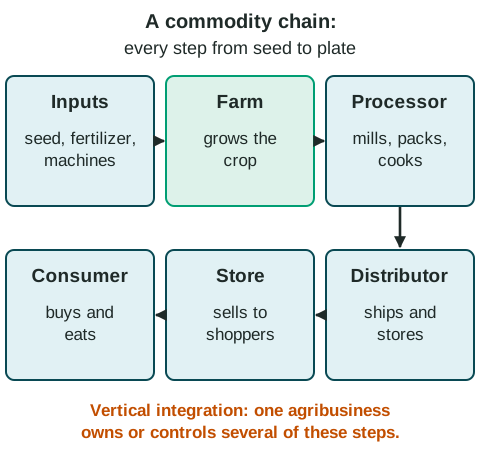
When one company owns or controls several steps of the chain, it is called vertical integration. In the US chicken industry, most birds are raised by farmers under contract to companies that own the chicks and feed and that also slaughter, pack and ship the meat. The farmer supplies the barns and labor and is paid by the contract.
Commodity chains can be local (a farm stand selling its own eggs), national (Kansas wheat milled into flour in Minneapolis and baked into bread in Chicago) or global (coffee grown in Colombia, roasted in the United States and sold in Japan). A farmer near the start of a long chain usually receives a small share of the final price.
Positive and negative effects
| Positive | Negative |
|---|---|
| Lower food prices for consumers | Fewer family farms; shrinking rural towns as families leave |
| More food from each hectare and each worker | Farmers depend on a few big buyers, who can set prices |
| Steady supply for stores and processors | Large animal operations concentrate manure and smell in one area |
Scale matters when you judge these effects. At the national scale, US food output rose while farm numbers fell. At the local scale, a county in Iowa may have lost its feed store and its school as neighboring farms were consolidated. Both are true at once.
Large operations are not the whole story. Small farms remain common worldwide, especially in South Asia and Sub-Saharan Africa, and in the United States most farms are still family-owned, even large ones. Many small US farms sell directly to customers at farmers markets, a niche that large operations do not serve.