
Drive out of Sacramento, California, and the land changes. Near the edge of town you pass small fields of vegetables and fruit stands. Farther out are large fields of rice and tomatoes for processing, and far into the hills are cattle ranches. That sorting is no accident. It follows who can pay the most for land at each distance from the market.
Subsistence and commercial agriculture
Subsistence agriculture is farming mainly to feed the farmer's own family. Families eat most of what they grow and sell any small extra. Rice farming on small plots in rural Bangladesh and maize and bean plots in much of rural Malawi are examples. Shifting cultivation and nomadic herding are usually subsistence systems.
Commercial agriculture is farming mainly to sell crops and animals for profit. Corn farms in Iowa, wheat farms in Kansas and soybean farms in Mato Grosso, Brazil, sell nearly everything they grow, usually to companies that process, store or ship it.
| Subsistence | Commercial | |
|---|---|---|
| Main goal | Feed the family | Sell for profit |
| Farm size | Usually small | Often large |
| Inputs | Mostly family labor | Machines, bought seed, fertilizer |
| Example | Rice plots in rural Bangladesh | Soybeans in Mato Grosso, Brazil |
Do not mix up these pairs. Subsistence and commercial describe the purpose of farming. Intensive and extensive describe inputs per hectare. A rice paddy in Bangladesh is subsistence and intensive; a cattle ranch in Argentina is commercial and extensive.
Monocropping and monoculture
Monocropping means growing the same crop on the same field year after year. A related term, monoculture, means growing one crop over a large area. Both are common in commercial agriculture because one crop is easier to plant and harvest with machines and to sell in bulk. Soybeans across Mato Grosso, Brazil, and corn across Iowa are examples. The risks: one pest, disease, drought or price drop can hit the whole harvest; and without rotation, soils lose nutrients, so farmers buy more fertilizer.
Bid-rent theory
Bid-rent theory says that land users compete, or bid, for land with the best access to a market. Land closer to the market costs more. Each kind of farming can pay a rent equal to what it earns per hectare minus its costs, including the cost of shipping its product to market. The use that can pay the most at each distance gets the land.
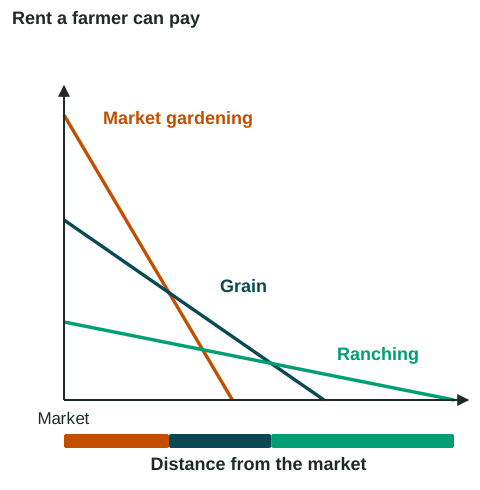
- Near the market: intensive uses that earn a lot per hectare and lose value fast with distance, such as market gardening and dairy, outbid the rest.
- Farther out: grain earns less per hectare but keeps well and ships cheaply, so it wins the middle distances.
- Far away: extensive uses such as ranching win where land is cheapest.
So land cost helps explain where intensive and extensive farming happen. Near Sacramento or Rotterdam, land is so costly that farmers use it intensively. In Patagonia or the Australian outback, land is cheap and used extensively.
Assumptions and limits. Bid-rent theory assumes one market, equal transport in every direction and farmers who want the most profit. Real regions have many markets, highways, rivers and rail lines that give some places better access, and land-use rules or government payments can change what farmers grow. Cheaper, faster transport also flattens the curves, letting intensive uses spread farther. You will meet bid-rent again inside cities.
Reading the pattern at different scales
At the local scale, land use around one town often follows the bid-rent order. At the national scale, a choropleth of a country's provinces may show the share of farm output sold for cash rising near the main market and falling in remote areas, where more families farm mainly to eat. At the global scale, commercial agriculture dominates in North America, Europe, Australia and much of South America, while subsistence farming remains common in parts of Sub-Saharan Africa and South and Southeast Asia, though many families there both eat and sell what they grow.