The world grows more food than ever, yet the UN's food agencies estimated that about 733 million people faced hunger in 2023 (FAO and partners, The State of Food Security and Nutrition in the World 2024). At the same time, shoppers argue over GMOs, fish farms and organic labels. This topic covers the big debates and challenges in farming.
Debates over new technology
GMOs. A genetically modified organism has genes changed in a lab. GMO corn, soybeans and cotton have been grown widely in the United States, Brazil, Argentina and India since the late 1990s and 2000s. Supporters point to crops that resist insects or survive weed killers, higher yields and less spraying of some insecticides. A 2016 review by the US National Academies of Sciences found no evidence that approved GMO foods are less safe to eat than other foods. Critics raise other concerns: weeds that become resistant to weed killers, patents that let a few companies control seed, and less crop variety. Many countries, including members of the European Union, limit or label GMO crops.
Aquaculture is the farming of fish, shellfish and seaweed in ponds, tanks or ocean pens. In 2022, for the first time, aquaculture produced more aquatic animals than wild capture fishing: 94.4 million tonnes, 51% of the total (FAO, The State of World Fisheries and Aquaculture 2024). It can ease pressure on wild fish, but some fish farms pollute water, spread disease to wild fish, or, like shrimp ponds on parts of Southeast Asia's coast, replace mangrove forests.
Food-choice movements
Many shoppers now choose food for reasons other than price.
| Movement | What it is | Example |
|---|---|---|
| Organic farming | Grown without most synthetic fertilizers and pesticides, under government rules | USDA Organic label in the United States |
| Local food | Food grown and sold nearby, often at farmers markets | A farmers market in a town square |
| Community-supported agriculture (CSA) | Members pay a farm in advance for a share of its harvest and share its risk | A weekly box of vegetables from a farm near Boston |
| Urban farming | Growing food inside cities, on vacant lots and rooftops | Urban farms on vacant lots in Detroit, Michigan |
| Value-added specialty crops | Products processed, branded or certified to earn more per unit | Farmstead cheese in Wisconsin; wine in the Napa Valley |
| Fair trade | A labeling system that pays producers a minimum price plus a premium, under labor and environmental rules | Fair trade coffee from cooperatives in Peru |
| Dietary shifts | Changes in what people eat, such as more or less meat | More plant-based diets in some places; more meat in others as incomes rise |
These movements can raise farmers' share of the price and cut shipping distance. They can also cost shoppers more, which limits who can take part.
Feeding the world
Food insecurity means not having reliable access to enough safe, nutritious food. Its causes are mostly about access and distribution, not total supply:
- Poverty and prices. Families who cannot afford food go hungry even where shops are full.
- Conflict and distribution. War and poor roads keep food from reaching people.
- Adverse weather. From 2020 to 2023, five rainy seasons failed in a row in the Horn of Africa (Ethiopia, Kenya and Somalia), killing livestock and crops.
- Farmland lost to building. On the edges of growing towns, as in California's Central Valley, new suburbs and roads cover some of the best soil.
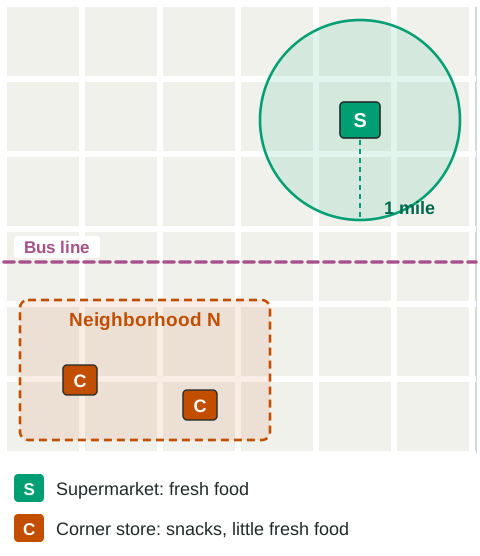
A food desert is an area where people have poor access to affordable, healthy food. The US Department of Agriculture counts an urban area as a food desert when it is low-income and many residents live more than a mile from a supermarket (10 miles in rural areas). Responses include new stores, farmers markets, urban farms and better bus routes.
The business of food
Where food is processed, how large operations are, how it is distributed and what governments do all shape what we eat. Bulky, perishable crops such as sugar beets are processed near the farms, because shipping them far would cost too much. Large operations can sell more cheaply, as you saw in earlier topics. Government policies, such as payments to farmers, import rules and food aid, change what is grown and where it is sold.