
In the early 1960s, many experts feared mass famine in South Asia, where population was growing fast. Instead, within a decade, India's wheat harvests had climbed sharply. New seeds, water and fertilizer had changed what a hectare could grow. That change is called the Green Revolution.
What the Green Revolution was
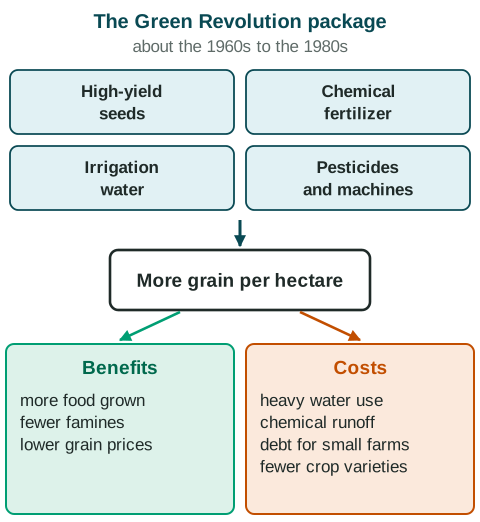
The Green Revolution was the spread of high-yield seeds, chemical fertilizer, irrigation, pesticides and machines to farms in many less developed countries, from the 1960s through the 1980s. Some textbooks call it the Third Agricultural Revolution. The name was coined in 1968.
At its center were high-yield varieties: seeds bred by crossing plants to produce much more grain when given water and fertilizer. Many were bred short, so heavy heads of grain would not knock the stalks flat.
- In Mexico, from the 1940s and 1950s, Norman Borlaug and other scientists bred short, disease-resistant wheat. Borlaug received the Nobel Peace Prize in 1970.
- In the Philippines, the International Rice Research Institute released IR8 rice in 1966.
- India, Pakistan and other Asian countries planted the new wheat and rice widely from the mid-1960s, especially on irrigated plains such as Punjab.
Green Revolution or GMO?
A genetically modified organism (GMO) is a plant or animal whose genes have been changed in a lab, for example by adding a gene from another species. The first GMO food went on sale in 1994, and GMO crops spread widely on farms from the late 1990s, decades after the Green Revolution. Green Revolution seeds were bred the old way, by crossing plants. Mixing the two up is a common exam mistake.
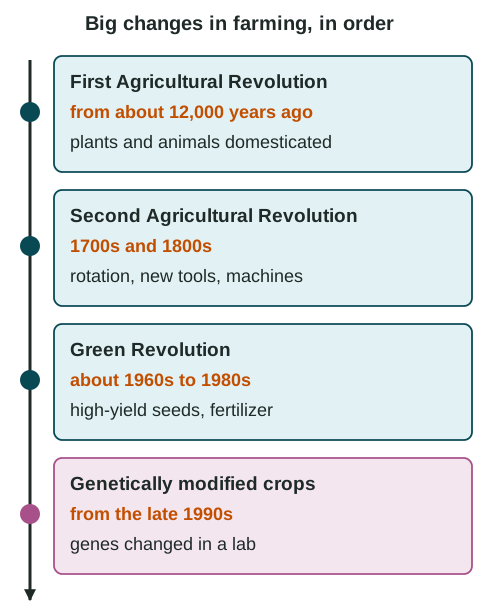
| Revolution | When | Where it began | Main changes |
|---|---|---|---|
| First | From about 12,000 years ago | Several hearths, such as the Fertile Crescent | Domestication; settled villages |
| Second | 1700s and 1800s | Britain, then North America | Rotation, breeding, enclosure, mechanization |
| Green (Third) | About 1960s to 1980s | Mexico, the Philippines, South Asia | High-yield seeds, fertilizer, irrigation |
| GMO crops (after it) | From the late 1990s | United States, then elsewhere | Genes changed in a lab |
Positive and negative effects
Positive effects. Grain output rose sharply in South and East Asia and Latin America. More food helped prevent famines that many expected, grain became cheaper, and the higher yield on each hectare meant less new land had to be cleared to feed more people.
Negative environmental effects. The package needs much water and chemicals. In Punjab, India, heavy pumping of groundwater for rice and wheat has lowered water tables. Fertilizer and pesticide runoff can pollute rivers and harm farm workers' health. Planting a few high-yield varieties in place of many local ones reduced the variety of crops farmers grew.
Negative social effects. Seeds, fertilizer, pumps and pesticides cost money. Larger farmers with water and credit often gained most, while some small farmers fell into debt or sold their land. Machines cut the need for hired labor in some areas.
Uneven spread. The Green Revolution focused on wheat and rice with irrigation. Much of Sub-Saharan Africa farms dry land without irrigation and grows crops such as millet, sorghum and cassava, so it gained much less. Results depend on the scale you study: a national total can hide regions that were left behind.
The Green Revolution and Malthus
Malthusian theory (1798) holds that population grows faster than food, so famine and other checks will follow. The Green Revolution is strong evidence against that prediction: food output in many countries grew faster than population. Neo-Malthusians reply that the gains relied on water, fertilizer made with fossil fuels and pumping that may not be sustainable, so the problem was delayed, not solved. Both views are worth knowing.