Picture the person who grew, sold and cooked your last meal. Depending on where you live, that might be a man on a tractor, a woman weeding a family plot, a woman trading vegetables in a city market, or all of them. Who does farm work differs from place to place, and those differences shape food supply.
Women's farm labor varies by place
Women's farm labor is the work women do in growing, processing, distributing and preparing food. How much they do, and which jobs, varies with culture, laws, the economy and the type of farming. These differences come from access and custom, not from ability.
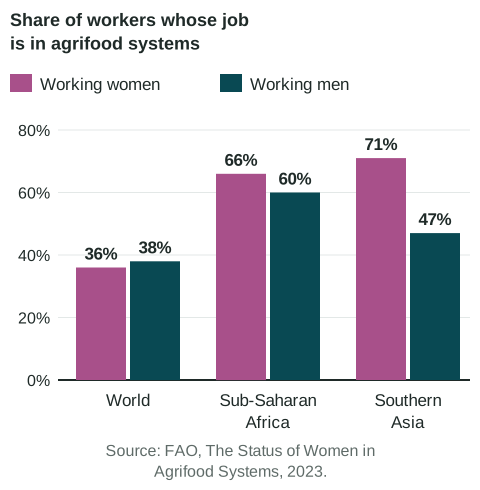
At the global scale, about 36% of working women and 38% of working men have jobs in agrifood systems (FAO, The Status of Women in Agrifood Systems, 2023). At the regional scale the picture changes. In Sub-Saharan Africa, 66% of working women and 60% of working men are in agrifood work. In Southern Asia, 71% of working women are, compared with 47% of men.
Roles at each stage of the food system
| Stage | Examples of women's roles |
|---|---|
| Production | Growing much of the food eaten at home on family plots in many parts of Sub-Saharan Africa; 36% of US farm producers in 2022 (USDA Census of Agriculture) |
| Processing | Making shea butter from shea nuts in Burkina Faso and Ghana; work in food-packing plants worldwide |
| Distribution | Market traders in cities such as Accra, Ghana, who buy from farmers and sell to shoppers |
| Consumption | In many households, buying and preparing food, which shapes what a family eats |
The type of production matters. On small subsistence farms, women and men often share work, with tasks divided by local custom. On large commercial farms, machines replace much hand labor, which can cut jobs that women once did, such as weeding or harvesting by hand, while new jobs appear in packing plants and trade.
Gaps and their effects
FAO's 2023 report found several gaps. Women in farm wage work earn about 82 cents for every dollar men earn. On farms of the same size, farms run by women produce about 24% less, a gap FAO links to unequal access to land, credit, seeds, fertilizer, training and markets. In 40 of 46 reporting countries, men were more likely than women to own or have secure rights to farmland. FAO estimates that closing the productivity and wage gaps could reduce the number of food-insecure people by about 45 million.
Secure land rights matter because a title can be used to get a loan, and because owners have reason to invest in the land, for example by planting trees or building terraces.
Change over time
Roles change. In parts of South Asia, including rural Nepal, many men have moved to cities or abroad for work, and women have taken on more of the farming and farm decisions at home. Some researchers call this the feminization of agriculture. In the United States, the share of farm producers who are women rose after the census began counting more than one producer per farm in 2017. Programs that give women land titles, loans or farm training aim to close the gaps described above.