Eat a bowl of chili and you are eating a world history lesson. The beans, chili peppers and tomatoes were first grown in the Americas. The beef came from cattle domesticated in Southwest Asia, and the onions from Central Asia. This topic is about where farming began and how crops and animals spread around the world.
Domestication and the First Agricultural Revolution
Domestication is the slow change of wild plants and animals into crops and livestock. People saved seeds from the plants with the biggest grains, or bred the calmest animals, and over many generations those species changed. Domesticated wheat, for example, keeps its seeds on the stalk at harvest instead of scattering them.
The First Agricultural Revolution (also called the Neolithic Revolution) was the shift from hunting and gathering to farming, which began about 12,000 to 10,000 years ago. Scientists still debate why it began; leading ideas include a warmer, steadier climate after the last ice age and slowly growing populations. Its effects are clearer:
- People settled in one place, near their fields and stored harvests.
- Farming produced a surplus, more food than farmers needed, so populations grew.
- Some people could do other jobs, such as making tools, trading or governing, and early towns and states formed.
Hearths of farming
A hearth is a place where something new begins. Farming had several hearths, each where people domesticated the wild plants and animals around them. That farming began in several places on its own is a key point: it was not invented once and copied everywhere.
| Hearth | Where | Early crops and animals |
|---|---|---|
| Fertile Crescent | An arc through Southwest Asia, from the eastern Mediterranean along the Tigris and Euphrates rivers | Wheat, barley, lentils; sheep, goats, cattle |
| Indus River valley | Pakistan and northwest India | Wheat, barley, cotton; cattle |
| Southeast Asia | Mainland and islands of Southeast Asia | Taro, yams, bananas; chickens |
| Central America (Mesoamerica) | Southern Mexico and nearby | Maize, beans, squash, chili peppers |
Other hearths include the Yellow and Yangtze river valleys of China (millet and rice), the Andes of South America (potatoes, quinoa, llamas), the Sahel and highlands of Africa (sorghum, coffee) and eastern North America (sunflowers, squash). Dates for each are debated and keep shifting as archaeologists find new sites, so learn the places and crops, not exact years.
Farming then spread out from each hearth. From the Fertile Crescent it moved into Europe over several thousand years, as farmers cleared land a little beyond their parents' fields. That is expansion diffusion: the practice spread outward while staying strong at home.
The Columbian Exchange
For thousands of years, the oceans kept the crops of the Americas apart from those of Africa, Europe and Asia. That changed in 1492, when Christopher Columbus sailed across the Atlantic. The Columbian Exchange was the transfer of plants, animals, diseases and people between the Americas and Afro-Eurasia that followed. It is named for Columbus, not for the country of Colombia.
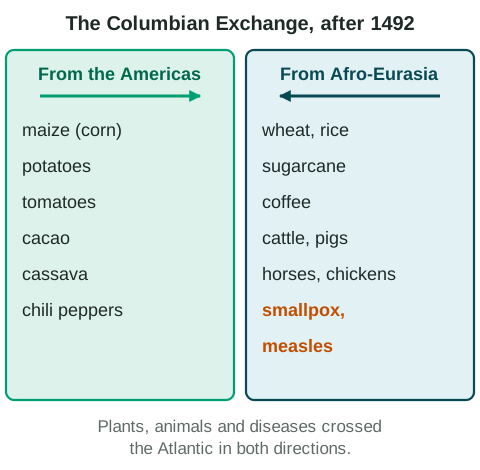
Its effects reached every scale. At the global scale, maize and cassava became staple foods in much of Africa, and the potato fed growing populations in Europe. At the national scale, Ireland came to depend on the potato, and when blight destroyed the crop from 1845 the famine killed about 1 million people and pushed more than 1 million to emigrate. At the regional scale, horses brought by the Spanish spread across the Great Plains, and nations such as the Comanche and Lakota built new ways of life around hunting bison on horseback. The exchange also had terrible costs. Diseases such as smallpox and measles, to which people in the Americas had no resistance, killed a very large share of the Indigenous population, and the sugar plantations of the Caribbean and Brazil relied on the forced labor of enslaved Africans.
The Columbian Exchange is relocation diffusion: crops and animals were carried by people across an ocean to distant places, not spread from neighbor to neighbor.