Look at any map of where people live and you will see that people are not spread evenly. Some places are packed with people; others are almost empty. The pattern of where people live is called population distribution. A population is the group of people who live in a place, such as a city, a country or the whole world. About 8.2 billion people lived on Earth in 2024 (UN World Population Prospects 2024).
The world pattern
At the global scale, most people live in a few large clusters:
- East Asia: eastern China, Japan and the Korean Peninsula, mostly on river plains and coasts.
- South Asia: India, Pakistan and Bangladesh, especially the Ganges River valley.
- Europe: from the United Kingdom across to western Russia.
Smaller clusters include West Africa (around Nigeria), the Nile valley in Egypt, the northeast of the United States and southeast Brazil. About six in ten people on Earth live in Asia (UN World Population Prospects 2024). Most people live in the Northern Hemisphere, on low land, and within reach of a coast or a river.
The ecumene is the part of Earth’s surface where people live permanently. Antarctica, the center of the Sahara and the high ice of Greenland lie outside it. The ecumene has grown over time as people learned to farm, build and move water in harder places.
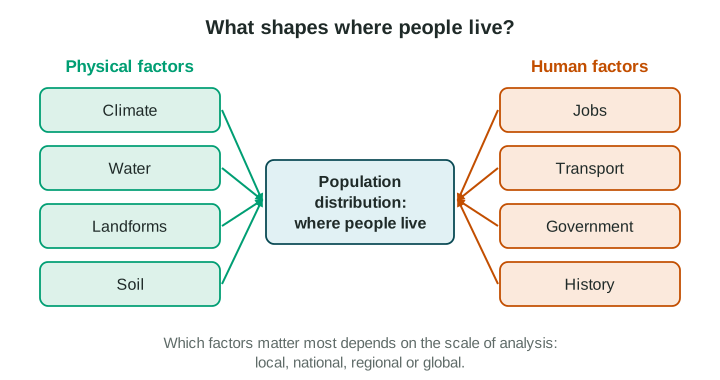
Physical factors
A physical factor comes from nature. Four matter most:
- Climate. Very cold places, such as northern Canada and Siberia in Russia, and very dry places, such as the Sahara, have few people.
- Water. People need water for drinking and for crops. In Egypt, a desert country, most people live along the Nile.
- Landforms. High, steep mountains such as the Himalaya are hard to farm and build on. Flat river plains are easier.
- Soil. Rich soil, such as the soil of river deltas, can feed many people.
Physical factors set limits, but they do not decide everything. That is the idea of possibilism from Unit 1: the environment offers choices, and people decide. Phoenix, in the desert of the southwestern United States, grew to more than a million people because people pumped and piped water to it and built air conditioning.
Human factors
A human factor is something people create. Jobs draw people, so cities grow where there are factories, offices and ports. Transport matters: towns line up along railways and highways. Government decisions matter: Brazil built its capital, Brasília, far inland in 1960 to draw people away from the crowded coast. History matters too: old farming regions such as the Ganges valley have held large populations for thousands of years.
| Factor | Kind | A real example |
|---|---|---|
| Water | Physical | Egypt’s people live along the Nile |
| Cold climate | Physical | Few people live in Siberia, Russia |
| Government decision | Human | Brasília, Brazil, built inland in 1960 |
| Jobs and trade | Human | Large port cities on coasts, such as Shanghai, China |
The scale changes the story
The pattern you see depends on the scale of analysis, the size of the area the data describe.
- At the global scale, Egypt looks like a country with many people.
- At the national scale, Egypt’s people are crowded into a small share of its land, in the Nile valley and delta, while the Western Desert is nearly empty.
- At the local scale, almost everyone in southern Egypt lives within a few kilometers of the river.
Australia shows the same lesson. At the national scale it seems to have few people for its size. At a closer scale, most Australians live in cities along the east and southeast coasts, and the dry interior has very few.
Worked example: describe a pattern. A weak answer says "Canada’s people are clustered." A strong answer says where: "At the national scale, most of Canada’s people live in a band near its southern border with the United States, and very few live in the cold north." It names the place, the pattern and the scale.
Why it matters
Where people live affects what a country must build and where: schools, hospitals, roads and water systems. The next topic looks at the effects of population distribution and at ways to measure how crowded a place is.