The last topic asked why people move. This one asks how much choice they had, and names the types of migration the exam expects you to know.
Forced or voluntary?
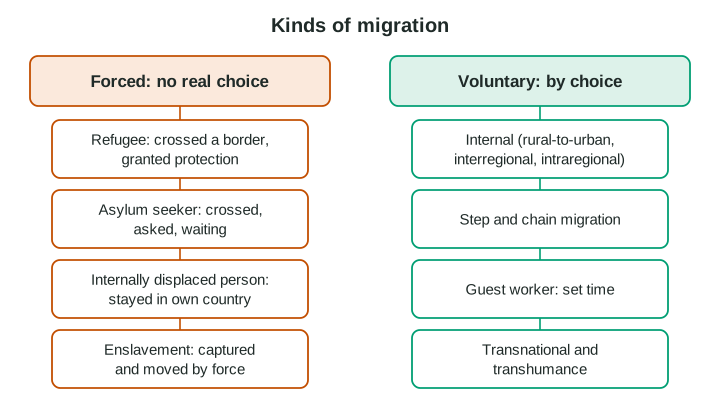
Forced migration happens when people are made to move: by enslavement, war, persecution or disaster. Voluntary migration happens when people choose to move, usually for work, family, study or a better life. Many real moves fall between: a family that leaves a region with no jobs and rising violence had some choice, but not much.
Forced migration
- Enslavement. Historians estimate about 12.5 million Africans were forced onto ships to the Americas between the 1500s and the 1860s (Trans-Atlantic Slave Trade Database).
- A refugee is a person who has crossed an international border because of danger or persecution and has been recognized as needing protection. The 1951 UN Refugee Convention names persecution for race, religion, nationality, membership of a social group or political opinion.
- An asylum seeker has crossed a border and asked for protection as a refugee but has not yet received a decision.
- An internally displaced person (IDP) has been forced from home but has stayed inside his or her own country. After war broke out in Sudan in April 2023, most of the millions who fled stayed inside Sudan (UNHCR, 2024).
The difference among the three is the border and the legal decision. Never call a person "illegal": the law defines what a person may do, not what a person is.
Voluntary migration
| Type | What it is | Real example |
|---|---|---|
| Internal migration | A move within one country. Interregional: between regions; intraregional: within one region, such as city to suburb | The Great Migration: about 6 million African Americans left the rural South for cities of the North and West, about 1910 to 1970 |
| Rural-to-urban migration | From the countryside to cities, the largest flow in many countries | Villagers in Oaxaca, Mexico, moving to Mexico City |
| Step migration | A move made in stages, often village to town to city | Village, then Mexico City, then Tijuana, then Los Angeles |
| Chain migration | Migrants follow relatives or neighbors who moved before them | Families from Puebla, Mexico, settling near relatives in New York |
| Guest worker | Allowed into a country to work for a set time | US Bracero Program (1942 to 1964); German programs with Italy, Türkiye and others (1950s to 1973) |
| Transnational migration | Migrants keep strong ties to two countries at once | Filipino nurses in Canada who send money and visit home |
| Transhumance | Herders move animals between pastures with the seasons | Herders in the Swiss Alps take cattle to high pastures each summer |
Step and chain migration echo Ravenstein: many moves happen in steps, and each new migrant makes the next move easier for relatives, who have a place to stay and help finding work.
Reading a flow map
A flow map draws migration as arrows: where people go, by which route and sometimes how many (by arrow width). A path that stops in several places shows step migration; many arrows to one place over the years can show chain migration. A flow map cannot show why people moved: for causes you need other sources, such as interviews or data on jobs and conflict.
Worked example: name the type and explain it. "The move is chain migration, because the migrant’s brother and cousins later followed him to the same neighborhood in New York, where he could give them a place to stay and help them find work."