Every culture trait started somewhere. Pizza, the Lunar New Year, a hit song, a way of writing: each began in one place and reached others. The spread of a trait from place to place is diffusion, and the place where it began is its hearth. Geographers sort diffusion into kinds because each kind leaves a different pattern on a map.
Relocation diffusion
In relocation diffusion, people who hold a trait move to a new place and take it with them. The trait does not need anyone in the new place to copy it; it arrives in the suitcases and memories of migrants. Irish migrants brought Saint Patrick's Day to Boston, Massachusetts: the first celebration there was in 1737, and Irish Bostonians were marching on the day by the 1840s. Italian migrants opened pizzerias in Buenos Aires, Argentina. This ties directly to Unit 2: wherever migrants go, including through chain migration, relocation diffusion follows.
Expansion diffusion and its three kinds
In expansion diffusion, a trait spreads outward from its hearth while it stays strong where it began. Think of K-pop, popular music from South Korea: it gained fans in many countries while staying hugely popular at home. Expansion diffusion comes in three kinds.
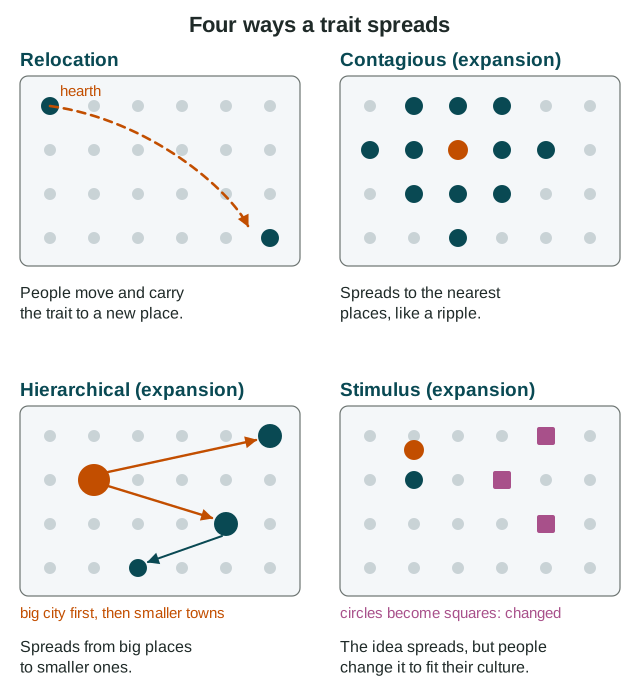
- Contagious diffusion spreads from person to person and from place to nearby place, like a ripple or a flu passing through a school. In a farming valley in Kenya, one farmer's successful new bean is copied by her neighbors, then theirs.
- Hierarchical diffusion spreads from large or powerful places or people to smaller or less powerful ones, skipping the places between. Fashion often goes from Paris and New York to smaller cities. Reverse hierarchical diffusion climbs the ladder instead: Walmart opened its first store in 1962 in the small town of Rogers, Arkansas, and filled small towns before it opened many stores in big cities.
- Stimulus diffusion spreads an idea that people change to fit their own culture. Sequoyah, a Cherokee silversmith, saw English speakers write but never learned English. By 1821 he had built a syllabary of 86 symbols for Cherokee syllables. The idea of writing spread; its form was new. Likewise, burger chains in India serve chicken and vegetable burgers because many customers do not eat beef.
| Kind | Do people move? | Pattern on a map | Example |
|---|---|---|---|
| Relocation | Yes | The trait appears far away, where migrants settle | Saint Patrick's Day parades in Boston |
| Contagious | No | A ripple outward from the hearth | A new bean copied farm to farm in Kenya |
| Hierarchical | No | Jumps between big places, skipping small ones | Fashion from Paris to smaller cities |
| Stimulus | No | The idea appears, but in a changed form | The Cherokee syllabary |
Real spread mixes the kinds
A model is a simple picture of something messy, and diffusion types are a model. Real traits rarely follow one kind. A new dance style might start in a capital city, jump to the next biggest cities (hierarchical), then ripple out to nearby towns from each of them (contagious). On the exam, name each stage and the evidence for it.
Two Unit 1 ideas shape the pattern. Distance decay means contact falls as distance grows, so contagious diffusion weakens far from the hearth. Time-space compression means fast transport and the internet shrink the effect of distance, so traits now jump between distant cities in weeks rather than years.
The model has limits. It sorts how a trait traveled but not why people accepted it, and a single map of dates often cannot tell you which kind happened: you may need interviews, records or data on who moved.
Worked example: read a diffusion map. A map of an invented country shows when a dance style became popular in each province: the capital in 2022, the provinces of the two next biggest cities in 2023, the provinces next to the capital in 2024, and rural provinces last.
- Hearth: the capital, the only province in the earliest class.
- First stage: the jump to the next biggest cities, ahead of other provinces just as close to the capital, is hierarchical diffusion.
- Second stage: the spread to provinces next to each city, then to rural ones, is contagious diffusion.
- Limit: the map shows when, not how. It cannot tell you whether the style spread by video, visitors or dance schools.