Today, a song can cross the world in an hour. For most of history, culture moved at the speed of a ship or a camel. Yet it still moved a long way. Three historical forces explain much of where languages, religions and customs are found: trade, colonialism and imperialism.
Trade carried culture
Merchants carried more than goods. Along the Silk Roads, which linked China with Central Asia, Southwest Asia and Europe, papermaking traveled west from China and reached Samarkand, in Central Asia, by about the 700s, then Baghdad and later Europe. Across the Indian Ocean, ports such as Kilwa, Mombasa and Zanzibar traded with merchants from Arabia, Persia and India for more than a thousand years. Swahili, a Bantu language of the East African coast, took in many Arabic words through that contact; its name comes from an Arabic word for "coasts."
Colonialism and imperialism
Colonialism is one country taking control of another place and its people, governing them directly and often sending settlers. Imperialism is wider: a country extending its power over other places by force, money or culture, whether or not it rules them directly. In the late 1800s, several powerful countries forced China to open ports to their trade without ruling all of China as a colony; that is imperialism.
Colonial rulers spread their languages, religions and laws, because they ran governments, schools and churches in their own way. The results still shape the global map:
| Place | Colonial ruler | Lasting trait |
|---|---|---|
| Brazil | Portugal (1500s to 1822) | Portuguese is the official language |
| Senegal | France (until 1960) | French in government and schools; Wolof widely spoken |
| India | Britain (until 1947) | English in courts, universities and national business; cricket |
| The Philippines | Spain, then the United States (1898 to 1946) | Mostly Roman Catholic, from Spanish rule; English beside Filipino |
The pattern is clearest at the global scale: cricket is a major sport in India, Pakistan, Australia and Jamaica, all once ruled by Britain, and little played in Brazil or Mexico, which had other rulers.
When cultures meet: new forms
Contact did not only replace one culture with another. Often it produced something new.
- A lingua franca is a shared language people use when their home languages differ. In the 1800s, trading caravans carried Swahili inland toward the Great Lakes, and traders, porters and farmers with different home languages used it to bargain. English plays this role on international flights.
- A pidgin is a simple mixed language that grows when groups with no shared language must trade or work together. No one speaks it from birth.
- Creolization is cultures mixing into a new local form. When children learn a pidgin as their first language, it grows into a full language, a creole.
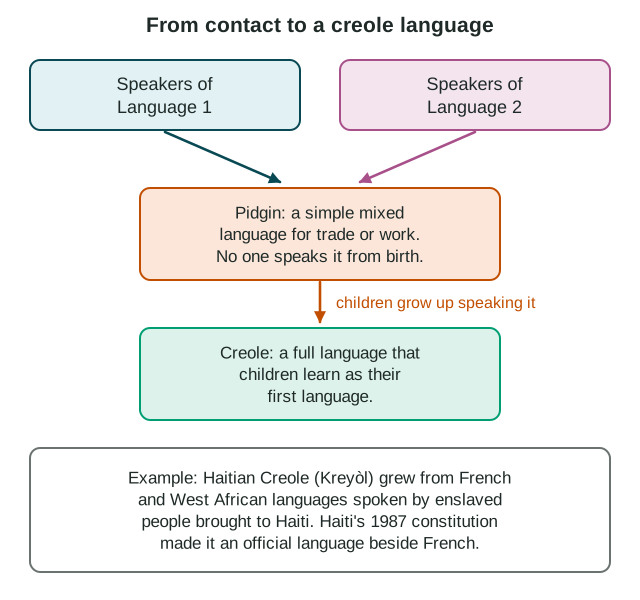
Haitian Creole grew from French and West African languages spoken by enslaved people brought to Haiti, and Haiti's 1987 constitution made it an official language beside French. Tok Pisin began in the 1800s as a work and trade language in what is now Papua New Guinea; many children there now grow up speaking it, and it is an official language. Creolization happens in food and music too: Louisiana gumbo mixes okra from West Africa, a French way of thickening sauce and ground sassafras leaves used by the Choctaw people.
Reading these forces on the exam
Historical questions ask you to explain a pattern with its cause. Name the place, the force and the link: "Portuguese is spoken in Brazil because Portugal ruled it for about 300 years and made Portuguese the language of government and schools." Keep colonialism and imperialism distinct, and do not call a lingua franca the home language of most people. Describe colonial history plainly: it spread culture, and it also forced it on people, often at great cost to the languages and ways of life already there.