For centuries, the sovereign state was the top level of power: each one ruled its own territory and answered to no one above it. Two trends now challenge that. Power moves down, from national governments to regions (devolution), and up, from states to organizations of states (supranationalism). Communication technology speeds up both.
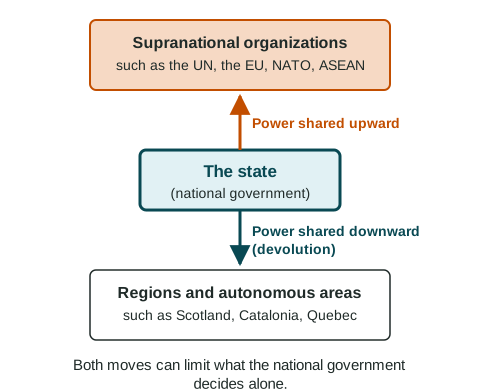
Power moving down: devolution and its results
Devolution can end in two ways. Most often, a state gives regions more power and stays whole. Spain, after its 1978 constitution, created autonomous communities, such as Catalonia and the Basque Country, with their own parliaments. Belgium became a federal state in 1993, with regions for Flanders, Wallonia and Brussels and separate communities for Dutch, French and German speakers. Canada created Nunavut in 1999, a territory in the north where Inuit are most of the people, so they could govern it largely themselves. Nigeria split its land into more and more states, from 12 in 1967 to 36 by 1996, partly to give its many peoples governments of their own.
Sometimes devolution goes all the way, and a state breaks apart. The Soviet Union became 15 states in 1991. After decades of war, people in southern Sudan voted in 2011 to leave Sudan, creating South Sudan. When a region breaks into smaller states that are often hostile to each other, geographers call it balkanization, after the Balkans in southeastern Europe, where Yugoslavia broke apart in wars in the 1990s.
Power moving up: supranationalism
Supranationalism is cooperation among three or more states through an organization for shared goals. States join for several reasons: problems that cross borders, such as pollution, disease and terrorism; larger markets, which let firms sell to more people at lower cost; and shared defense. In return, members give up some sovereignty. Organizations differ by function, so learn what each one does rather than how many members it has, which changes over time.
| Organization | Main function | How it limits members' sovereignty |
|---|---|---|
| United Nations (UN), 1945 | Peace, security and cooperation | Members agree to carry out Security Council decisions |
| NATO, 1949 | Military alliance | An armed attack on one member is treated as an attack on all; used for the first time after the attacks on the United States on 11 September 2001 |
| European Union (EU), 1993 | Single market, shared laws, a shared currency (the euro) for most members | Members follow EU laws and EU court rulings in shared areas and allow free movement of people |
| ASEAN, 1967 | Cooperation in Southeast Asia | Little: it works by agreement and avoids stepping into members' internal affairs |
| African Union, 2002 | Peace, security and development in Africa | May step in to stop genocide or war crimes; suspends members after a coup |
| Arctic Council, 1996 | Protecting the Arctic environment and the lives of its peoples | Little: it is a forum whose decisions need all eight Arctic states, with six Indigenous peoples' groups taking part |
The costs and benefits are argued over. In 2016, 51.9% of UK voters chose to leave the EU, many saying they wanted to "take back control" of laws and borders; 48.1% voted to stay, and the UK left in 2020. Other states have joined bodies for protection: Finland joined NATO in 2023 and Sweden in 2024.
Communication technology
Fast, cheap communication helps people share ideas and organize across space. It can help devolution (a regional movement spreads its message in its own language), supranational cooperation (officials in many capitals work together every day) and democratization, the spread of democratic government in which people choose leaders in free elections. In Tunisia in 2010 and 2011, protesters used mobile phones and social media to share news and plan marches, and the long-time ruler left power. Governments can use the same tools to watch and control people, so technology does not push only one way.
Scale
These changes happen at different scales at once. At the global scale, states pool power in the UN; at the regional scale, in the EU or the African Union; at the national scale, they share power with provinces; at the local scale, autonomous areas such as Nunavut govern themselves. A strong answer names the scale at which sovereignty is being shared.