Every state must decide who makes which decisions, and where. Is a rule made in the capital for the whole country, or does each region make its own? Geographers sort states into two main forms by how they spread power across space: unitary and federal.
Unitary states: power at the center
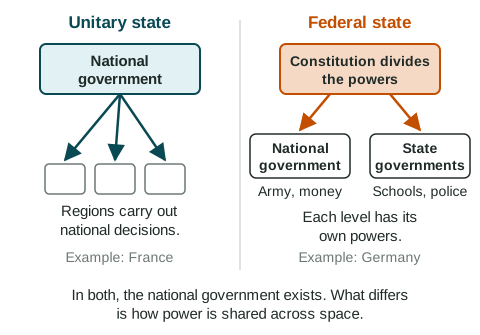
A unitary state concentrates power in the national government. The country may be divided into regions, but those regions carry out national decisions and have only the powers the national government gives them. The national parliament can create, change or remove regional powers by passing an ordinary law.
France is the classic example. The national government in Paris sets what is taught in schools across the country and runs the national police. Japan and China are also unitary states. Unitary systems are common in states that are small or where most people share one culture, because one set of rules fits most places. They make policy simple and the same everywhere, but people far from the capital may feel ignored.
Federal states: power shared by constitution
A federal state divides power, through its constitution, between a national government and regional governments (called states, provinces or, in Germany, Länder). Each level has powers of its own that the other cannot simply take away. The United States, Germany, India, Brazil, Canada, Mexico, Nigeria and Australia are federal states.
In the United States, the Tenth Amendment (1791) reserves to the states every power the Constitution does not give to the national government. So at the subnational scale, laws differ from state to state: minimum wages, speed limits and many school rules change when you cross a state line. The national government still runs defense, foreign policy and money. The readers who score the exam report that students describe a federal state as if it had no national government. Always name both levels.
Why a state chooses one form
Federal systems often suit states that are very large, such as Brazil, Canada and Australia, where distant regions have different needs. They also suit states that hold many nations or language groups. After 1956, India redrew many of its states largely along language lines, and each runs many of its own affairs, such as policing. In Nigeria, a federal system gives its many peoples their own state governments. Switzerland, small but with four national languages, is federal too. So size alone does not decide the form: culture and history matter as much.
| Unitary state | Federal state | |
|---|---|---|
| Where power sits | Mostly in the national government | Shared between national and regional governments |
| Regional powers | Given by the center, and can be taken back by ordinary law | Protected by the constitution |
| Laws across the country | Mostly the same everywhere | Some laws differ from region to region |
| Often found in | Smaller or more culturally uniform states | Very large or culturally diverse states |
| Examples | France, Japan, China | United States, Germany, India, Nigeria |
In between
The two forms are ends of a range. A unitary state can give special powers to one region: Finland is unitary, but its Åland Islands, where most people speak Swedish, make many of their own laws. The United Kingdom is unitary, yet Scotland, Wales and Northern Ireland have their own parliaments or assemblies. Such cases show that the way power is spread can change over time, which is the subject of the next topics.