Cities change constantly, and change brings winners and losers. This topic covers housing discrimination, the clearing and rebuilding of neighborhoods, rising costs, and the challenges of fast-growing cities, along with the policies used to respond. For each, give both sides.
Redlining and blockbusting
Redlining is refusing loans, insurance or other services, or offering worse terms such as higher interest rates, based on the location of a property. In the 1930s, the federal Home Owners' Loan Corporation graded neighborhoods in many US cities from A (green) to D (red). Areas graded D, often because Black or immigrant families lived there, were marked "hazardous", and lenders and federal mortgage programs largely avoided them for decades. Owners in those areas could not get loans to buy or repair homes, so buildings declined and wealth did not build up. Remember both parts: the mechanism is about location; the history is about race.
Blockbusting was a practice in which real estate agents frightened white homeowners into selling quickly and cheaply by claiming that Black families were moving onto the block, then sold the same houses at much higher prices to Black families shut out of other areas. It was common in Chicago and other cities in the 1950s and 1960s. The Fair Housing Act of 1968 outlawed discrimination in selling, renting and lending, including blockbusting, and the Community Reinvestment Act of 1977 pushed banks to lend in every neighborhood they serve.
Urban renewal
Urban renewal is a government program that buys, clears and rebuilds areas it judges to be run-down. The US Housing Act of 1949 paid for many such projects. In Boston, the West End, a crowded neighborhood of immigrant families, was cleared in the late 1950s and replaced with high-rise apartments. Supporters pointed to new housing, modern buildings and a larger tax base. Critics pointed to thousands of families forced to move, many with little help, and to close-knit communities destroyed. Many cleared districts were home to Black families, and highway building cut through others, as in St. Paul's Rondo neighborhood.
Gentrification
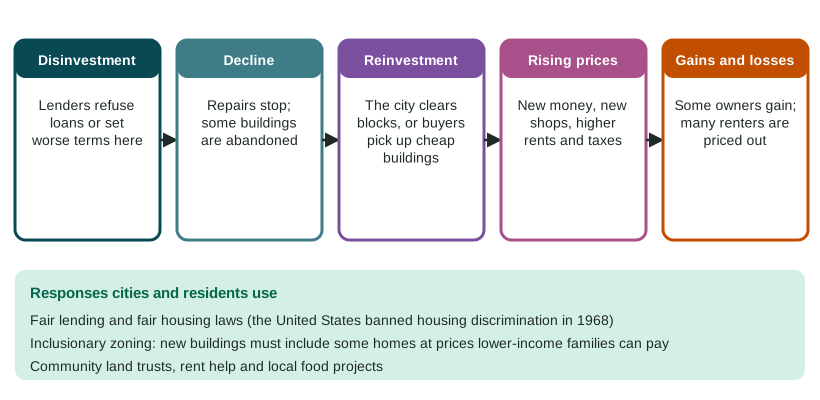
Gentrification is the movement of higher-income residents and investment into a lower-income neighborhood, raising property values and changing its character. It often starts where housing is old but well built and close to downtown or transit. Brooklyn's Williamsburg and San Francisco's Mission District are well-known US examples; the word itself was coined about London in 1964.
| Who may gain | Who may lose |
|---|---|
| Owners who sell or whose homes gain value | Renters whose rents rise faster than their pay, who may be displaced |
| The city, through higher property tax revenue | Long-time residents who lose neighbors, churches and shops they relied on |
| Residents who welcome repairs, new stores and safer-feeling streets | Small businesses whose old customers move away or whose rents climb |
Geographers disagree about how much displacement gentrification causes in each case, so judge the evidence for the place in front of you.
Other challenges of urban change
- Affordability and access to services. When housing costs rise, lower-income families move farther out, away from jobs, transit, clinics and good schools. Some areas become food deserts.
- Disamenity zones. A disamenity zone is one of the poorest, least-served parts of a city, sometimes a zone of abandonment with empty buildings, sometimes steep slopes or land beside dumps where the newest arrivals settle, as in many Latin American cities. Crime is often higher where services and jobs are scarce.
- Squatter settlements and land tenure. Land tenure is the right to occupy and use land. Residents of squatter settlements, such as the favelas of Rio de Janeiro, Brazil, often lack legal title, so they risk eviction and have little reason to invest in their homes. Some cities upgrade settlements instead of clearing them: Rio's Favela-Bairro program, begun in 1994, added paved paths, water and sewers.
- Environmental injustice. Environmental injustice is the unequal burden of pollution and environmental harm on poor and minority communities. In 2014, Flint, Michigan, a majority-Black city, switched its water source to save money, and lead from old pipes entered tap water. A task force appointed by Michigan's governor concluded in 2016 that the crisis was a clear case of environmental injustice.
- Fragmented local government. Many US metro areas are split among dozens of separate cities, counties and school districts. Each sets its own taxes and zoning, so it is hard to plan transit or share costs, and wealthy suburbs may keep their tax revenue while the central city carries the costs of poverty.
Responses
Inclusionary zoning requires or rewards developers who include a share of homes priced for lower- and middle-income households in new buildings. Montgomery County, Maryland, began one of the first programs in 1974. Supporters say it keeps neighborhoods mixed; critics say it can slow building or raise prices of the other units. Other responses include rent help, community land trusts that keep land in community hands, fair-lending enforcement, local food projects such as community gardens, and regional planning bodies that span many local governments.