Before about 1750, most goods were made by hand. A family in the English countryside might spin wool and weave cloth at home, then sell it to a trader. Making goods at home like this is called cottage industry. Within a hundred years, much of that cloth came from huge mills in towns, run by machines and staffed by people who had left their farms. That change is the Industrial Revolution: the shift from making goods by hand to making them with machines and new sources of power in factories. The spread of factories and machine work to a place is called industrialization.
Why it began in Great Britain
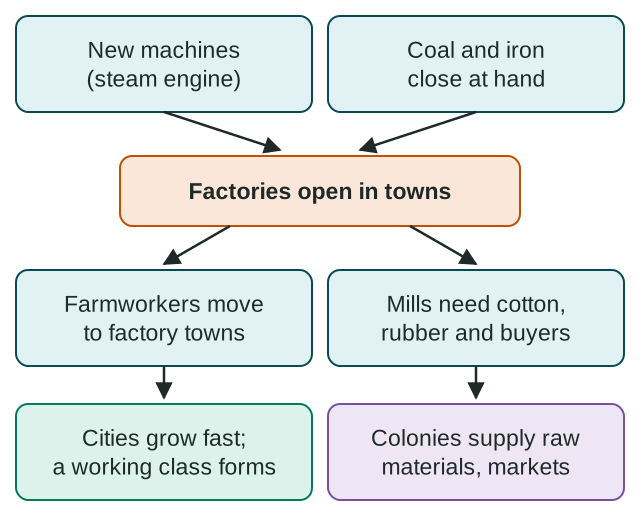
Industrialization needs two things at once: new technology and the resources to run it. Great Britain in the late 1700s had both.
- New technology. Spinning and weaving machines made cloth far faster than hands could. In the 1770s James Watt's improved steam engine gave factories power that did not depend on a fast river.
- Resources close at hand. Britain had coal to burn in steam engines and iron ore to make machines, often in the same districts, such as the coalfields around Manchester in northwest England.
- Food and workers. New farm methods of the Second Agricultural Revolution grew more food with fewer farmworkers. That food could feed town workers, and the farmworkers no longer needed on farms could move to towns.
- Money and trade. Merchants who had grown rich from overseas trade, including trade with colonies, had money to build mills.
Before steam, a mill had to sit beside a fast stream that turned its water wheel. Steam power broke that tie. Factories could now locate in towns, close to coal, to workers and to buyers, so factories clustered together.
How industrialization spread
From Britain, factories spread in the 1800s to other places with coal and iron: Belgium around Liège, northern France, the Ruhr valley of Germany and Upper Silesia (now mostly in Poland). Across the Atlantic, textile mills opened in New England in the United States, at towns such as Lowell, Massachusetts, in the 1820s. Japan began to industrialize after 1868, when its new government brought in foreign machines and advisers and built railways and mills. Each place added its own changes, but the mix was the same: machines, power and raw materials.
Changes at three scales
| Scale of analysis | What changed | Example |
|---|---|---|
| Local | Mill towns grew fast, with crowded housing, smoke and disease | Manchester, England, grew from a market town into a factory city in a few decades |
| National | People moved from farms to towns (rural-to-urban migration), and a country became mostly urban | In the 1851 census, more people in England and Wales lived in towns than in the countryside for the first time |
| Global | Factories drew raw materials from distant places and sold goods worldwide | British mills used cotton grown in the US South, India and Egypt and sold cloth back to India |
New food supply, more people, new classes
More food and, later, cleaner water and better medicine let death rates fall while birth rates stayed high, so the population grew. The demographic transition model you met in Unit 2 was built largely on this history in Europe.
Society changed shape too. Factory owners and a growing middle class of managers, clerks and engineers grew richer. A large working class of people who earned wages in factories formed in the cities. Early mills used long shifts and child labor; workers' groups and new laws, such as Britain's Factory Act of 1833, began to limit them.
Raw materials, markets and empire
Factories need a steady flow of raw materials and buyers for what they make. That need pushed industrial countries to gain control over other places. Colonialism (one country ruling another territory) and imperialism (building power and control over other places) were not new, but industrialization raised the stakes. Britain's mills turned raw cotton into cloth, and cheap British cloth was sold in India, which hurt India's own hand weavers. Later in the 1800s, European powers claimed most of Africa, often to secure rubber, palm oil and minerals for their factories.
Worked example: explain, with every link. Question: explain one way the Industrial Revolution changed cities.
A weak answer says "cities grew." A full answer names a place and gives every link: "In Manchester, England, steam-powered textile mills opened in the early 1800s, so they needed many workers; farmworkers who were no longer needed on farms moved to the city for factory wages, which led to rapid growth and crowded, unhealthy housing."
Limits of the story
The Industrial Revolution was not one event at one moment. It took more than a century, it happened at different times in different places, and its costs fell unevenly: on factory workers, on enslaved people who grew cotton in the US South, and on colonized places whose own industries were undercut. When you explain it on the exam, name the place and the time, and say who gained and who lost.