Bananas grow well in Costa Rica's warm, wet lowlands but not in Canada. Canada grows large amounts of wheat and makes machinery. So bananas go north and wheat goes south. Trade like this seems obvious when one place cannot make what another can. The surprise is that trade also pays when one country can make everything more cheaply than the other. This topic explains why, and how rules, groups of countries and debt tie the world economy together.
Complementarity
Complementarity exists when one place has a supply of something that another place needs, so trade between them makes sense. Costa Rica and Canada complement each other because of climate. Saudi Arabia exports oil that Japan, with very little oil of its own, needs; Japan exports cars and machines that Saudi Arabia buys. Without complementarity, there is little reason to trade.
Absolute and comparative advantage
To produce one thing, a country gives up the chance to produce something else with the same workers and land. What it gives up is the opportunity cost. Two kinds of advantage use different tests:
- A country has an absolute advantage in a good if it can produce more of it with the same resources.
- A country has a comparative advantage in a good if it can produce it at a lower opportunity cost: it gives up less of the other good.
Trade should follow comparative advantage, not absolute advantage. The idea goes back to the British economist David Ricardo in 1817.
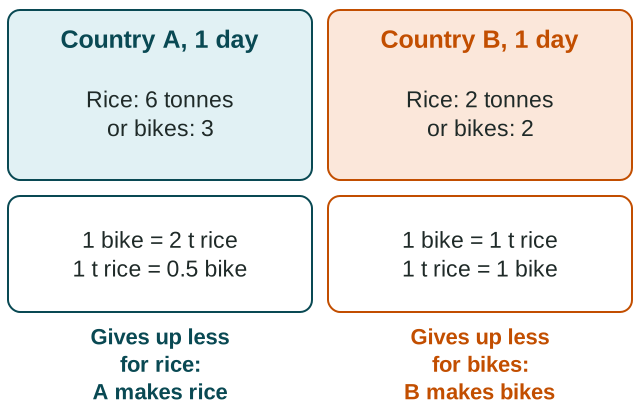
Worked example: find the comparative advantage (invented data). In one day of work, Country A can make 6 tonnes of rice or 3 bikes. Country B can make 2 tonnes of rice or 2 bikes.
- Absolute advantage. A makes more rice (6 against 2) and more bikes (3 against 2), so A has the absolute advantage in both.
- Opportunity cost of one bike. In A, 3 bikes cost 6 tonnes of rice, so one bike costs tonnes of rice. In B, one bike costs tonne of rice.
- Opportunity cost of one tonne of rice. In A, it costs bike. In B, it costs bike.
- Comparative advantage. A gives up less to make rice (0.5 bike against 1), so A has the comparative advantage in rice. B gives up less to make bikes (1 tonne against 2), so B has the comparative advantage in bikes.
- Gain from trade. If A makes rice and B makes bikes, and they trade at a price between their two opportunity costs, say 1.5 tonnes of rice for one bike, both end up with more than they could make alone.
The common slip: saying A should make both goods because it is better at both. That is absolute advantage. Trade follows the lower opportunity cost.
Neoliberalism and the rules of trade
Neoliberalism is a set of policies that shrink the government's role in the economy: lowering taxes on trade, selling state-owned companies to private owners, cutting government spending and letting markets set prices. From the 1980s these ideas shaped many governments and the international bodies that lend and set trade rules.
- A tariff is a tax on imported goods. It makes imports cost more, which protects a country's own producers but raises prices for buyers, and other countries may answer with tariffs of their own.
- The World Trade Organization (WTO), set up in 1995, writes rules for trade among its members, pushes them to lower tariffs and settles trade disputes.
- A trade bloc (or trade agreement) is a group of countries that lower or remove tariffs among themselves. The European Union lets goods, money and people move freely among its members, and the United Kingdom left it in 2020. Mercosur was founded in 1991 by Argentina, Brazil, Paraguay and Uruguay. The United States, Mexico and Canada trade under the USMCA, which replaced NAFTA in 2020. Trade blocs are a kind of supranational organization, so members give up some control over their own trade policy.
- OPEC, the Organization of the Petroleum Exporting Countries (founded 1960), is a group of oil-exporting countries that agree on how much oil to produce in order to influence its world price.
Governments also act at smaller scales. A national government may offer tax breaks for factories in a poorer region; a US state or a city may offer a carmaker free land and lower taxes to win a new plant.
Debt, the IMF and interdependence
The International Monetary Fund (IMF), set up in 1944, lends to governments in financial trouble. In 1982 Mexico said it could not pay its foreign debts, and a debt crisis spread across Latin America. The IMF and other lenders offered new loans, but with conditions called structural adjustment: cut government spending, sell state companies and open markets to trade. Supporters say these steps restored growth and trust; critics say the spending cuts hit schools, clinics and the poorest people hardest. In 2010 Greece needed rescue loans from other EU countries and the IMF, with spending cuts as a condition.
These links make the world economy interdependent: what happens in one place spreads. In 2008 a crisis that began with risky home loans in the United States spread to banks, trade and jobs around the world. Even at the local scale, interdependence shows: microloans funded by investors far away reach a borrower in a Bangladeshi village.