Think about a cotton T-shirt. A farmer in Texas or India grows the cotton. A factory worker in Dhaka, Bangladesh, sews the shirt. A truck driver and a store clerk get it to you. A designer and a data analyst decide what the next shirt should look like, and a company's top officers decide where it will be made. Each of these people works in a different part of the economy. Geographers sort jobs into economic sectors: groups of jobs that do the same kind of work.
The five sectors
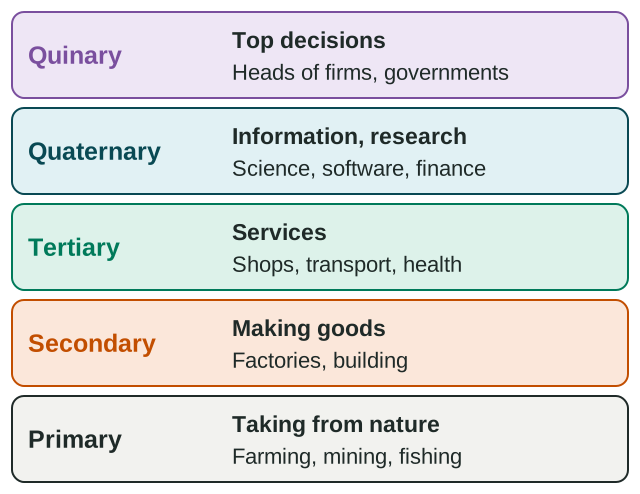
| Sector | What workers do | Real example |
|---|---|---|
| Primary sector | Take resources straight from nature | Copper miners in northern Chile; rice farmers in the Mekong Delta, Viet Nam |
| Secondary sector | Turn raw materials into goods (manufacturing, building) | Garment workers in Dhaka, Bangladesh; car assembly in Puebla, Mexico |
| Tertiary sector | Provide services to people and firms (shops, transport, health care, teaching) | Port workers in Rotterdam, Netherlands; nurses in any hospital |
| Quaternary sector | Create and move information (research, software, finance) | Software engineers in Bengaluru, India |
| Quinary sector | Make the highest-level decisions | Top officers of big firms in London; senior government officials |
The tertiary sector is also called the service sector. The quaternary and quinary sectors are parts of services that are split out because they matter so much in rich economies. A useful test: a quaternary worker handles information; a quinary worker makes the final call on what a whole firm or government does.
Where factories locate
A factory owner wants to make goods at the lowest total cost. Geographers group the costs that depend on location into a few kinds.
- Labor. Sewing clothes takes many hands, so garment factories locate where wages are low, as in Bangladesh.
- Raw materials and energy. Aluminum smelters use huge amounts of electricity, so several have been built in Iceland, where hydroelectric and geothermal power are plentiful.
- Markets. Some goods are cheaper to make close to the people who buy them.
- Transport. Every tonne moved costs money. Since the shipping container came into use in the 1950s, goods can move from ship to train to truck without being unpacked, which made long-distance shipping much cheaper. That let factories locate far from the buyers of their goods.
Least cost theory says a factory locates where its total costs of transport, labor and nearby firms are lowest. It sorts industries into two kinds:
- A weight-losing (bulk-reducing) industry makes a product lighter than its raw materials. Copper ore is mostly waste rock, so copper is smelted near the mines of northern Chile: shipping the metal costs far less than shipping the rock.
- A weight-gaining (bulk-gaining) industry makes a product heavier than its inputs. A soft-drink bottler adds water, which is found almost everywhere, so bottling plants sit close to the cities where the drinks are sold.
Like every model, least cost theory is simplified. It assumes every firm only wants the lowest cost and knows all its costs. Real firms also chase tax breaks, skilled workers, a pleasant place to live and a government that welcomes them, and those can outweigh transport costs.
Break-of-bulk points
A break-of-bulk point is a place where goods are moved from one kind of transport to another, such as from ships to trains or barges. Ports are the classic case. At Rotterdam, at the mouth of the Rhine River in the Netherlands, cargo from ocean ships moves onto river barges, trains and trucks bound for Germany and beyond. Because goods are unloaded there anyway, it is cheap to process them on the spot, so refineries and factories cluster at break-of-bulk points.
Sectors in different parts of the world
Places differ in which sectors employ most people. One way to group countries by the work they do in the world economy uses three tiers:
- The core: countries with mostly high-wage service, research and decision jobs and advanced industry. Germany, Japan and the United States are often classed as core.
- The periphery: countries where many people work in the primary sector and in low-wage jobs, often exporting raw materials. Chad and Niger are often classed as periphery.
- The semiperiphery: countries in between, with a large factory sector and growing services. Brazil, Mexico and India are often classed as semiperiphery.
These groups are categories of a model you will study fully in Topic 7.5, not an official list, and countries can move between them. At the national scale, a country's mix of sectors changes over time: as incomes rise, the share of workers in farming usually falls, factory work rises and then levels off or falls, and services grow. At the local scale the mix can differ sharply from the national one: Bengaluru has far more quaternary workers than rural Karnataka around it.
Worked example: sort a job. A geologist searches for oil for a mining firm. Is that primary or quaternary? The work is research that produces information (where the oil is), so it is quaternary, even though it serves a primary-sector firm. Sort by what the worker does, not by the firm's product.