In 1976 an economics professor in Bangladesh, Muhammad Yunus, lent a small sum from his own pocket to a group of village women who made bamboo stools. They had been borrowing from moneylenders at very high interest, which kept them poor however hard they worked. With the loan they bought their own materials, sold their stools and paid him back. From that start grew the Grameen Bank, which lends small amounts mostly to poor women. In 2006 Yunus and the Grameen Bank shared the Nobel Peace Prize. Their story opens a bigger question: how do women's roles change as a place develops, and who gains?
How women's work changes with development
In places where most people farm, women do a large share of the farm work you met in Unit 5, plus most of the unpaid work at home: cooking, fetching water and caring for children and older relatives. Unpaid work is real work, but it is not counted in GDP.
As a country develops, several changes tend to come together:
- More girls go to school and stay longer (female education, from Unit 2).
- Fertility falls, so women spend fewer years caring for babies.
- Factory and service jobs grow, and many are open to women.
So more women take paid work outside the home. In Bangladesh, the garment industry around Dhaka grew from the 1980s on, and most of its workers have been women. Their wages gave many women income of their own and more say at home. The jobs also brought risks: long hours, low pay and unsafe buildings. In 2013 the Rana Plaza factory building near Dhaka collapsed and killed more than 1,100 people, most of them garment workers, which led to new building-safety agreements.
More work, but not equal work
Paid work does not mean equal work. The gender wage gap (or gender pay gap) is the difference between what women and men earn on average, often given as women's pay as a percent of men's. It appears in most countries that collect the data, rich and poor. Its causes include:
- Women are crowded into lower-paid jobs and sectors, and are fewer among managers and in the quinary sector.
- Women do more unpaid care work, so they more often work part time or leave work for years.
- Some employers pay women less for the same work (discrimination), even where laws forbid it.
Opportunity is unequal too: in many places women have less access to bank loans, land titles and seats in government. That is why the Gender Inequality Index you studied in Topic 7.3 measures empowerment and labor force participation as well as health.
Places respond in different ways. Iceland passed a law in 2017 that requires larger employers to prove they pay women and men equally for work of equal value. Rwanda has had a majority of women in the lower house of its parliament since its 2008 election (Inter-Parliamentary Union data). Both show that policy, not development alone, shapes women's opportunities.
Microlending and small businesses
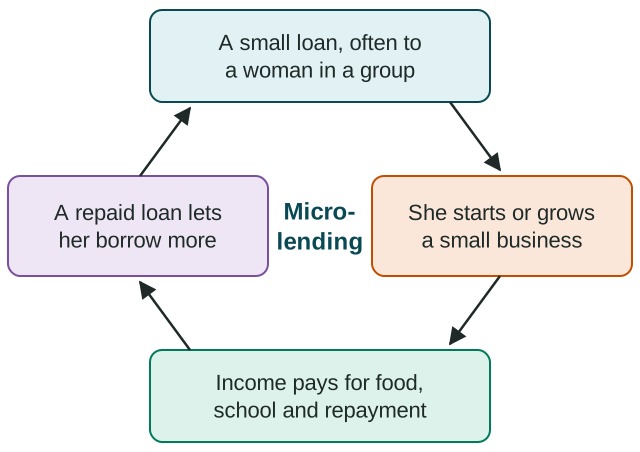
Microlending (also called microcredit or microloans; the wider field is microfinance) means making very small loans to people too poor to borrow from ordinary banks, often to start or grow a small business. Many lenders lend to women in small groups: the members meet often, back each other and feel responsible to the group, so repayment rates have often been high. A woman in Bangladesh might borrow enough to buy a cow and sell its milk, or a sewing machine to make clothes.
| Possible benefits | Possible problems |
|---|---|
| Income a woman controls, often spent on food, health and children's schooling | Interest rates can be high, and a failed business leaves a debt |
| A small business can grow and hire others | Many borrowers start the same small businesses, so they compete for the same buyers |
| More say in household decisions | Some borrowers take new loans to repay old ones and fall deeper into debt |
The problems are real. In 2010, in the Indian state of Andhra Pradesh, many borrowers had loans from several lenders at once and struggled to repay, and the state government restricted how lenders could operate. Studies in several countries have found that microloans often help families manage money but rarely lift whole communities out of poverty on their own. Microlending works best alongside schooling, health care and fair access to land and markets.
Worked example: name the scale. "At the local scale, a microloan let a woman in a village near Tangail, Bangladesh, buy a sewing machine, so she earned her own income and paid her daughter's school fees. At the national scale, the garment industry gave millions of Bangladeshi women paid work, but the gender wage gap and unsafe workplaces show that more work is not the same as equal work."