In 1980, Shenzhen was a small town in southern China, across the river from Hong Kong. That year China's government made it one of its first special economic zones, with low taxes and few rules for foreign firms. Factories poured in, and within a few decades Shenzhen became one of China's largest cities and a world center of electronics. Over the same years, factory towns in the US Midwest and northern England lost many of their jobs. Both changes are parts of one story: how the world economy moved work from place to place.
Outsourcing and deindustrialization
Outsourcing means a firm hires another firm to do part of its work, often in another country where costs are lower (sending work abroad is also called offshoring). A US firm may have its customer calls answered in Manila, the Philippines, or its software tested in Bengaluru, India. Lower shipping costs and faster communication made this possible.
When factories close or move away and a region's share of factory jobs falls, the region goes through deindustrialization. Detroit, Michigan, lost much of its car industry from the 1970s on, as plants moved to cheaper places or used more machines; the city's population fell for decades. Workers in core countries shifted toward service jobs, while factory jobs grew in other places.
Where the jobs went
A newly industrialized country (NIC) is a country whose economy shifted quickly from farming toward factories and exports. South Korea and Singapore are often given as examples from the 1960s to the 1990s; China, Mexico and Malaysia from later decades.
Many governments drew factories with a special economic zone (SEZ): an area with lower taxes, fewer rules and cheaper land for firms that make goods for export. Related forms are free-trade zones and export-processing zones. China opened its first four SEZs in 1980 (Shenzhen, Zhuhai, Shantou and Xiamen, all on its southeast coast) and added Hainan Island in 1988. Mexico's maquiladoras, factories near the US border, many in cities such as Tijuana and Ciudad Juárez, import parts without paying tariffs, assemble them and send the goods back to the United States.
The result is an international division of labor: different stages of making a product happen in different countries. A smartphone may be designed and its software written in California (quaternary work), its chips made in South Korea, and its parts assembled in China (secondary work), before it is sold worldwide (tertiary).
From Fordism to post-Fordism
In 1913 Henry Ford's car plant near Detroit began using a moving assembly line: each worker did one simple task, and huge numbers of identical cars came off the line. This way of making goods, called Fordism, relied on large factories, mass production of one product and long-term jobs in one place.
Post-Fordism is the more flexible way of making goods that spread from the 1970s: smaller batches of many different products, work split among many firms and places, and workers trained to do several tasks. A key part is just-in-time delivery, made famous by Toyota in Japan: parts arrive at the factory just when they are needed, so the firm keeps little stock. It saves money, but it makes factories depend on every supplier: a single blocked port or closed supplier can stop the line.
Why industries cluster, and how growth spreads
- Economies of scale (from Unit 5): making goods in large amounts lowers the cost of each one.
- Agglomeration: firms in the same or linked industries cluster in one place because being close helps them all. They share skilled workers, suppliers, ideas and services. Silicon Valley in California is the classic agglomeration of tech firms; Bengaluru's software firms are another.
- Multiplier effect: new jobs in one industry create more jobs in others. Workers at a new plant spend their wages at local shops and restaurants, and suppliers hire too. The effect also runs in reverse: when a big plant closes, shops and suppliers lose business.
- Growth pole: a key industry or major investment, often planned, whose growth spreads to the region around it through the multiplier effect. When BMW opened a car plant near Spartanburg, South Carolina, in 1994, parts suppliers and services followed and the region's economy grew around it.
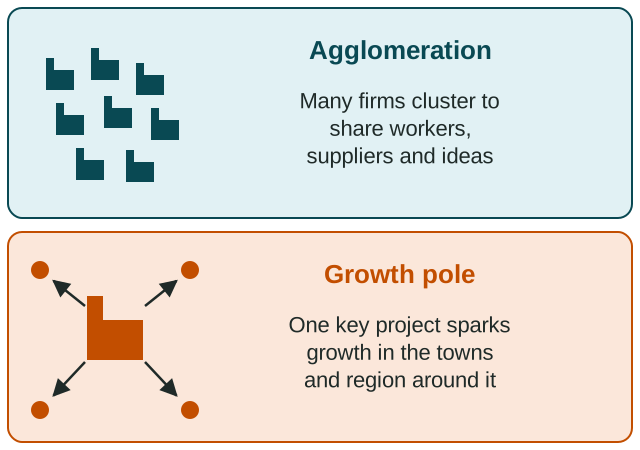
| Agglomeration | Growth pole | |
|---|---|---|
| What it is | A cluster of many firms in one place | One key industry or project that drives a region |
| Why it happens | Firms gain from being near each other (shared workers, suppliers, ideas) | A large investment, often planned by a government or one big firm |
| Direction | Pulls firms in | Pushes growth out to the surrounding region |
| Example | Silicon Valley, California | BMW's plant near Spartanburg, South Carolina |
The two often go together: a growth pole can grow into an agglomeration as suppliers arrive. On the exam, say which idea fits and why.
Services and high tech
As factory work moved, service and high-tech work grew in many places. High-tech firms cluster near universities and research centers, such as the research parks around Cambridge, England, and Bengaluru, India. Call centers and back-office work grew in the Philippines and India, where many workers speak English. These changes have winners and losers at every scale: new jobs and fast-growing cities in some places, lost jobs and shrinking towns in others.