Every limit so far asked what happens as approaches a number. Now let run off forever, to the right or to the left. Where does head? The answer describes the far ends of a graph, and it settles which of two growing quantities wins in the long run.
Limits at infinity and horizontal asymptotes
means that as grows without bound, gets as close to as you like. means the same as decreases without bound. When either limit is a finite number , the line is a horizontal asymptote: the graph levels off toward it.
The basic fact behind everything here: as , , and so do , and . A fixed number divided by something growing without bound shrinks to 0.
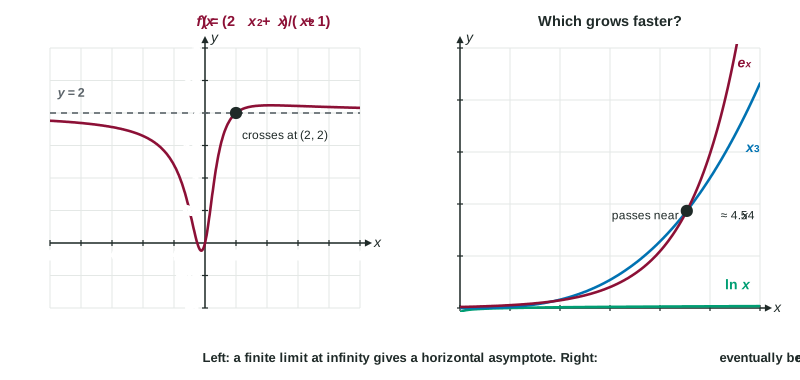
A horizontal asymptote is about the far ends only. In the middle the graph may cross it: equals 2 at and still approaches 2 as . Vertical asymptotes are different: next to one the function is unbounded, and for a rational function the line itself is outside the domain, so the graph runs along it instead of crossing it.
| Vertical asymptote | Horizontal asymptote | |
|---|---|---|
| Limit | ||
| is | approaching a number | growing without bound |
| is | growing without bound | approaching a number |
| Can the graph cross it? | not for a rational function (undefined on the line) | yes, away from the far ends |
Rational functions: divide by the dominant power
For large , only the highest-power terms matter. To make that precise, divide the top and the bottom by the highest power of in the denominator.
Worked example 1. Find .
Divide every term by : .
As , and , so the limit is . The graph has the horizontal asymptote .
The same steps give three cases:
| Degrees | Limit at | Example |
|---|---|---|
| top = bottom | ratio of leading coefficients | |
| top < bottom | ||
| top > bottom | unbounded; no horizontal asymptote |
Square roots: watch the sign
is , not . For positive that makes no difference. For negative it does: .
Worked example 2. Find both limits at infinity of .
For large , .
As : , so .
As : , so .
Two horizontal asymptotes: and .
A related trick handles forms such as : multiply by the conjugate to get , then divide by . The limit is .
Exponentials, logarithms and the race to infinity
Some functions grow without bound, but at very different speeds. In the long run:
slowest , then , then , then , then fastest
"Slower" means the quotient of the slower function over the faster one approaches 0:
Worked example 3. Find .
The dominant term in both the top and the bottom is . Divide everything by it:
The exponential beats , so ; and . The limit is 3.
On the left the story changes: , so is a horizontal asymptote of on that side only. Bounded oscillations also fade when divided by something growing: for , so by the squeeze theorem