The last topic described breaks in a graph. This topic turns "no break" into a precise test you can apply to a graph, a table or a formula, and write up as a justification. The test has three conditions, and every one of them matters.
The definition
A function is continuous at when all three of these hold:
- is defined. (There is a point on the graph at .)
- exists. (The curve arrives at one height from both sides.)
. (The point is exactly where the curve arrives.)
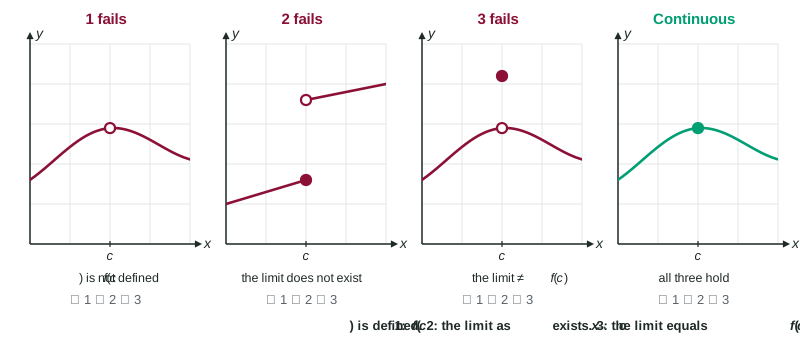
Each condition catches a different kind of break. Check them in order: the first one that fails is your reason.
| First condition to fail | What the graph shows | Kind of discontinuity |
|---|---|---|
| 1: undefined | no point at | removable (a hole) or infinite, depending on the limit |
| 2: the limit does not exist | the two sides arrive at different heights, or grow without bound | jump or infinite |
| 3: limit | a hole with the point placed elsewhere | removable |
Checking a formula
Worked example 1. Let for and . Is continuous at ?
Condition 1: , so it is defined.
Condition 2: for ,
Condition 3: . It fails.
Conclusion: is not continuous at 2, because
Checking a piecewise function
At a break point, the one-sided limits come from different pieces. Find each one, then compare.
Worked example 2. Let for , , and for . Show that is continuous at .
Condition 1: .
Condition 2:
Condition 3:
All three hold, so is continuous at .
Notice the write-up. Each condition gets its own sentence with its own number. "The pieces match" or "there is no break" is a conclusion, not a justification.
Reading a graph or a table
On a graph, ask three questions at . Is there a closed dot? Does the curve arrive at the same height from both sides? Is the dot at that height? A closed dot at the end of one piece (a jump) passes the first question and fails the second. A dot floating above a hole passes the first two and fails the third.
A table can suggest continuity: if is listed and the values on both sides close in on 2, continuity at is likely. As always, a table estimates the limit; it does not prove it.
Why continuity matters
If is continuous at , then
Later in the course, big theorems start with "if is continuous". Each time, you will need to say why the function is continuous before you use the theorem. This definition is where that habit begins.