Some quantities grow or shrink by the same percentage in each equal stretch of time: a savings account, a bacteria culture, a drug leaving the blood, the gap between a cup of coffee's temperature and the room's. These are modeled by exponential functions, and calculus has a favorite one, . Its partner, the natural logarithm , lets you solve for a time hidden in an exponent. This page reviews both and the rules that connect them.
Exponential functions and the number
An exponential function has the variable in the exponent: , with a positive base . Each step of 1 in multiplies the output by . With the function shows exponential growth; with , exponential decay.
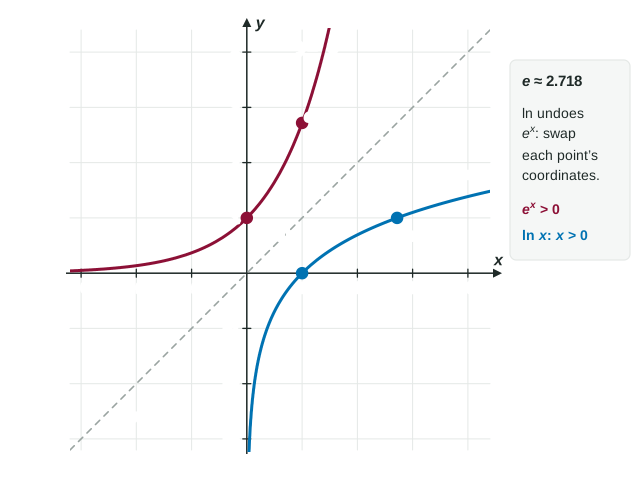
Calculus works best with one particular base, . The reason will appear in Unit 2: is the function whose rate of change equals its own value, which makes every formula involving it clean. For now, know its graph and its rules:
- , so the graph passes through .
- for every . The graph never touches the -axis; the -axis is a horizontal asymptote on the left.
- All the exponent rules apply: , , , .
The natural logarithm
The natural logarithm answers one question: what power of gives ? So , , and . Since is always positive, is defined only for .
Because undoes and undoes , they cancel each other:
Log rules
Every log rule is an exponent rule read backward. Multiplying powers adds exponents, so the log of a product is a sum:
| Rule | Example |
|---|---|
And the rules that do not exist, which are the classic slips:
| Wrong | Why |
|---|---|
| a sum of logs comes from a product: | |
| , a different thing | |
| there is no rule for a quotient of logs |
Worked example 1. Simplify and .
, so . Move the coefficient into the log before canceling and .
Solving exponential and log equations
To free a variable from an exponent, isolate the exponential, then take of both sides. To free a variable from inside a log, isolate the log, then raise to both sides.
Worked example 2. Solve .
Isolate: . Take : . Solve: .
A common slip is dividing by 2 inside the log: is a different number.
Growth and decay with
A quantity that starts at and grows or decays continuously at a steady percentage rate is written . The number sets the speed: for growth, for decay. Two questions come up constantly: when does it reach a level, and how long does it take to double or halve?
Worked example 4. A sample of grams halves every 5 hours. Find .
, so , so .
per hour. The negative sign confirms decay.
On a calculator question, store and other intermediate values rather than rounding them, and give the final answer to three decimal places.