Picture a bead sliding back and forth on a straight wire. Its location on the wire, measured from a fixed origin, is its position at time . Particle motion questions appear on the free-response section of nearly every exam, and they all rest on three functions and the signs they take. This page builds them one at a time.
Position, velocity, acceleration
Choose a positive direction, usually right (or up). The position function is positive to the right of the origin and negative to the left. Then:
- The velocity is the rate of change of position: .
- The acceleration is the rate of change of velocity: .
Units follow the rule from the last topic, output per input. With position in meters and time in seconds, velocity is in meters per second, and acceleration is in meters per second per second (written m/s²).
Worked example 1. A particle has position meters, for seconds. Find and , and describe the motion at .
At : , , . The particle is 2 meters right of the origin, moving left at 3 meters per second.
Direction, rest and turning around
The sign of the velocity tells the direction: means moving right, means moving left. The particle is at rest when .
A particle changes direction only where changes sign. Being at rest for an instant is not enough. For , the particle stops at , but is positive on both sides, so it keeps moving right. On the exam, "the particle changes direction at because " does not earn the point; "because changes from negative to positive at " does.
In Worked example 1, is positive on , negative on , and positive on . The particle moves right, then left, then right again, turning around at and .
Speed, and speeding up
Speed is the size of the velocity: . A velocity of m/s and a velocity of m/s have the same speed, 5 m/s. Speed is never negative.
When is the speed increasing? Think of pushing a moving cart. Push in the direction it is going and it speeds up; push against it and it slows down. Acceleration is the push. So:
| The particle is | ||
|---|---|---|
| moving right, speeding up | ||
| moving right, slowing down | ||
| moving left, speeding up | ||
| moving left, slowing down |
Speeding up when and have the same sign; slowing down when their signs are opposite. A negative acceleration alone does not mean slowing down.
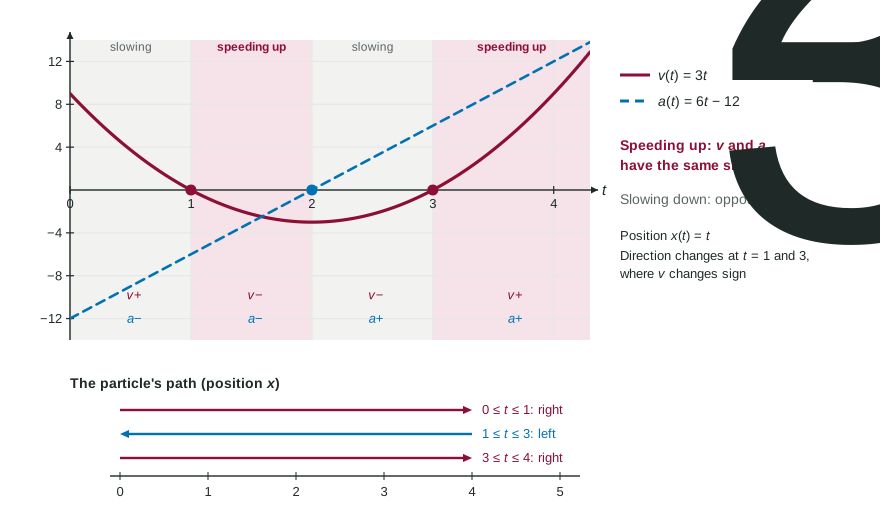
Worked example 2. For the same particle, is it speeding up or slowing down at and at ?
At :
At : but . Opposite signs, so it is slowing down as it approaches its stop at .
Reading a velocity graph
Often you get the graph of instead of a formula. Then:
- The height of the graph is the velocity; above the axis means moving right.
- Where the graph crosses the -axis, the particle changes direction.
- The slope of the graph is the acceleration.
- Speeding up: the graph is moving away from the -axis. Slowing down: moving toward it.
Worked example 3. A graph of is a segment from to . Describe the motion at .
The segment has slope , so . Its height there is
Both negative: the particle is moving left and speeding up. The graph is below the axis and moving away from it, which agrees.
Slips that cost points
- Claiming a direction change where without a sign change.
- "Slowing down because " without checking the sign of .
- Giving a negative speed, or calling velocity and speed the same thing.
- Wrong units: acceleration is distance per time per time.
- Product and chain rule slips when is something like : .