Unit 2 treated the derivative as a slope. Out in the world it is a rate: kilometers per hour, dollars per item, degrees per minute. Every free-response question set in a real situation asks you to find such a rate, give its units, and say what it means in a sentence. The mathematics is the derivative you already know; the new skill is reading it, and writing about it, precisely.
Units: output per input
The derivative is the limit of difference quotients . The top is a change in the output; the bottom is a change in the input. So the units of a derivative are always
| Function | Output | Input | Units of the derivative |
|---|---|---|---|
| , depth of snow | centimeters | hours | centimeters per hour |
| , cost of bicycles | dollars | bicycles | dollars per bicycle |
| , temperature | °C | minutes | °C per minute |
| , volume of a balloon | cm³ | cm of radius | cm³ per cm |
The input is not always time. For the balloon, tells how fast the volume grows per extra centimeter of radius.
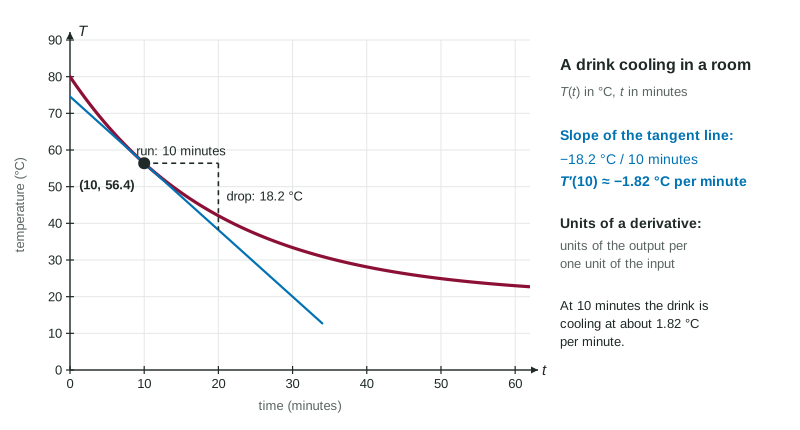
Interpreting a derivative in a sentence
A full interpretation of names four things:
- the instant (the value of the input, with its units),
- the quantity, by its name in the problem,
- whether it is increasing or decreasing (from the sign),
- how fast, with units.
Worked example 1. is the number of liters of water in a tank minutes after noon, and . Interpret.
"At 12:20 (that is, minutes), the amount of water in the tank is decreasing at 4 liters per minute."
Notice the sign became the word "decreasing", and the number became its size, 4. Writing "changing at liters per minute" is also correct.
Two sentences that lose the point: "At 20 minutes there are 4 liters" (that would be , an amount, not a rate) and "In 20 minutes the tank lost 4 liters" (a change over an interval, not a rate at an instant).
Estimating a derivative from a table
Real data come as tables. To estimate , use the two inputs closest to on either side, and divide by their actual difference:
Worked example 2. Snow depth , in centimeters, after hours:
| (hours) | |||||
|---|---|---|---|---|---|
| (cm) |
Estimate : the closest times around 8 are 6 and 10.
At hours the snow is getting deeper at about 0.725 centimeters per hour.
The widths in a table are often unequal, on purpose. Dividing by 2 out of habit here would give 1.45, which is wrong. Also show the difference quotient itself; a bare number does not earn the setup point.
A rate times a short time is a change
Because a derivative is a rate, it lets you estimate small changes: change rate time. If a calf gains weight at kilograms per day, then over the next 2 days it gains about kilograms. This works only over short stretches, where the rate stays nearly the same.
Comparing rates
A statement such as , where is a tree's height, compares speeds of growth: the tree was growing faster at 4 years than at 8 years. It says nothing about which height was larger. Keep amounts () and rates () separate in every sentence.
Slips that cost points
- Units of the function instead of units of the rate ("centimeters" for ).
- Upside-down units ("hours per centimeter").
- Describing an amount or a total change when the question asks about a rate.
- Leaving out the instant ("is increasing at 1.1 cm per hour", but when?).
- Using the wrong width from a table with unequal spacing.