Motion is one story the derivative tells. It tells many others: how fast a medicine leaves the blood, how fast a town grows, how much one more kilogram of coffee adds to a roaster's cost. The calculus is identical in every case. What you must get right is the language: which quantity, increasing or decreasing, how fast, and in what units. This page also handles the second derivative in context, the rate at which a rate changes.
One pattern, many settings
| Quantity | Its derivative means | Units of the derivative |
|---|---|---|
| temperature , °C, in minutes | how fast it warms or cools | °C per minute |
| population , people, in years | how fast the town grows | people per year |
| cost , dollars, in kilograms | cost of one more kilogram (approximately) | dollars per kilogram |
| concentration , mg/L, in hours | how fast the medicine level changes | mg/L per hour |
The sentence is always built the same way: "At [input value], [the quantity] is increasing (or decreasing) at [the size of the derivative] [units]."
Worked example 1. A town's population is people, years after 2020. Find and interpret .
By the chain rule,
In 2030 the population is increasing at about 12.2 people per year.
Worked example 2. The concentration of a medicine is mg/L, hours after a dose. Find and interpret and .
: one hour after the dose, the concentration is increasing at 0.96 mg/L per hour.
Rates of rates
A derivative is a function, so it has its own rate of change, the second derivative. In context, its units carry the input unit twice: if is in °C and in minutes, then is in °C per minute per minute.
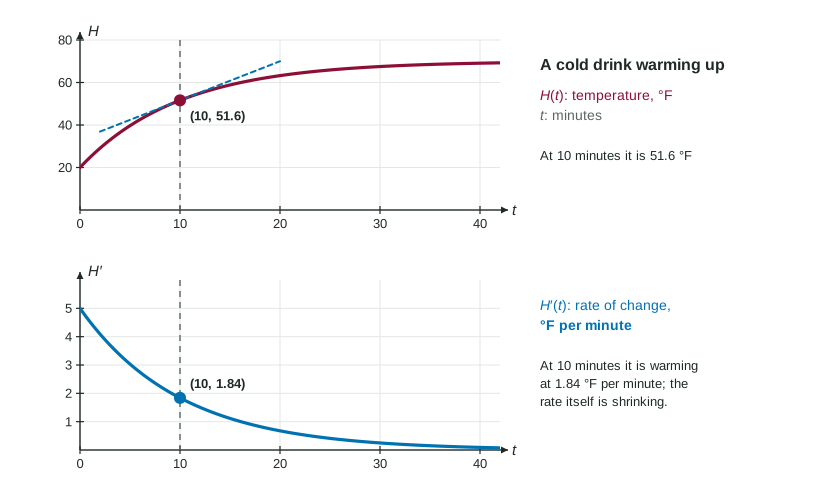
Read the two signs separately. The sign of says whether the temperature rises or falls. The sign of says whether that rate is growing or shrinking:
| In words | ||
|---|---|---|
| increasing, faster and faster | ||
| increasing, more and more slowly | ||
| decreasing, faster and faster | ||
| decreasing, more and more slowly |
Worked example 3. Soup cools by °C. Describe the cooling at .
, so °C per minute: the soup is cooling.
, so °C per minute per minute: positive, so the rate of cooling is easing off.
Together: at 10 minutes the soup is cooling at about 1.88 °C per minute, and the cooling is slowing down.
Watch for a function that is already a rate. If water leaks out of a tank at liters per hour, then means the leak rate is decreasing at 2 liters per hour per hour. It says nothing directly about the amount of water left.
Chained quantities
Sometimes one quantity depends on another that depends on time. A balloon's temperature reading depends on its altitude, and its altitude depends on time. The chain rule multiplies the rates, and the units cancel the same way:
Checking that the units cancel is a fast way to catch a setup error.
Slips that cost points
- Reporting the amount () when the question asks for its rate ().
- Giving a second derivative the units of the first ("°C per minute" for ).
- Reading the sign of as whether itself increases.
- Dropping the chain rule factor in models like , which also flips the sign.
- On a calculator question, rounding before the end, or giving fewer than three decimal places.