Some of the most memorable problems in calculus are pictures: a ladder sliding down a wall, a cone-shaped tank filling with water, a person walking away from a streetlight while the shadow grows. The calculus in them is short. What takes the time, and where most mistakes happen, is the geometry: writing the one equation that connects the quantities in the picture. This page gathers the geometry you need and shows the two tools that do most of the work.
Formulas to know by heart
The exam gives no formula sheet, so these must be automatic:
| Shape | Area or volume | Other |
|---|---|---|
| Rectangle, triangle | , | |
| Circle | circumference | |
| Semicircle | is half the diameter | |
| Trapezoid | average of the parallel sides times the height | |
| Equilateral triangle, side | height | |
| Box | ||
| Cylinder | curved surface | |
| Cone | one third of the cylinder | |
| Sphere | surface |
A quick check catches many slips: areas have squared units and volumes have cubed units. If your "volume" formula has and nothing else with a length, something is missing.
The Pythagorean theorem
Whenever a picture has a right angle, the Pythagorean theorem links the three sides: , where is the hypotenuse, opposite the right angle. Calculus problems use it as an equation between changing quantities.
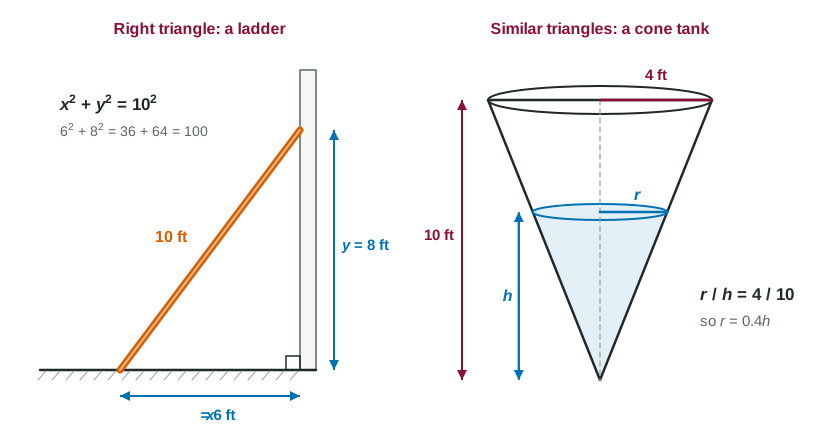
Worked example 1. A 10-foot ladder leans against a wall. Let be the distance from the wall to its foot and the height of its top. Write an equation, and find when .
The wall meets the ground at a right angle, and the ladder is the hypotenuse: .
When : , so feet.
The equation holds at every moment as the ladder slides; that is what Unit 4 will use.
The same theorem gives the distance between two cars moving along perpendicular roads, the length of a kite string, and the height of an equilateral triangle.
Similar triangles
Two triangles are similar when they have the same three angles. Then one is a scaled copy of the other, and every pair of matching sides has the same ratio. Look for a small triangle sitting inside a big one, sharing an angle.
Worked example 2. A cone-shaped tank, point down, is 10 feet tall with a top radius of 4 feet. Write the volume of water as a function of its depth .
The water is a small cone inside the tank. Viewed from the side, the water's triangle and the tank's triangle are similar: , so .
Substitute into the cone formula:
Now depends on one variable only. Replacing with before doing any calculus is the key step.
Worked example 3. A person 6 feet tall stands 10 feet from a lamppost 15 feet tall. Find the length of the shadow.
The light, the top of the person's head and the tip of the shadow line up. The big triangle has height 15 and base ; the small triangle has height 6 and base .
, so , so , and feet.
The most common slip is using 10 as the big triangle's base instead of .
Right-triangle trigonometry
When an angle is part of the question, use the right-triangle ratios:
A routine for picture problems
- Draw the picture, even if one is given.
- Label every quantity that changes with a letter and every fixed quantity with its number.
- Find the right angle or the similar triangles, and write one equation.
- If the formula has too many variables, use a ratio or the Pythagorean theorem to eliminate one.
Substitute a specific moment's numbers (like ) only at the end. If you put them in too early, the equation stops describing the changing picture.