Here is the kind of limit you will meet again and again: . Substitute and both the top and the bottom are 0. The limit laws cannot help, because the denominator heads to 0. The way forward is to rewrite the fraction into a form where the trouble disappears. That takes three precalculus moves, and this page drills each one: factoring, rationalizing and simplifying complex fractions.
Factoring
To factor is to rewrite a sum as a product. A factored form shows what each piece is multiplied by, and that is what lets pieces cancel. The patterns you need:
| Pattern | Example |
|---|---|
| Common factor | |
| Difference of squares: | |
| Trinomial : two numbers that multiply to and add to | |
| Difference of cubes: | |
| Sum of cubes: |
A useful shortcut: if a polynomial is 0 at , then is one of its factors. So when substitution gives 0 on top at , you already know to look for the factor .
Worked example 1. Factor . The leading coefficient is not 1, which is where most errors happen.
Multiply . Find two numbers that multiply to and add to : they are 6 and .
Split the middle term and group:
Check by expanding:
Cancel factors, never terms
Canceling divides the top and bottom by the same nonzero factor. A term that is added cannot be canceled. This is the single most common algebra error on limit questions.
| Wrong | Right |
|---|---|
| does not simplify: has no real factors | |
| does not simplify |
When in doubt, test a number. At ,
Rationalizing with a conjugate
When a square root sits next to a number, as in , factoring does not apply directly. Instead multiply by its conjugate, the same expression with the opposite sign in the middle: . A conjugate pair multiplies to a difference of squares, and the square root disappears: To keep the fraction's value, multiply the top and the bottom by the conjugate. This is called rationalizing.
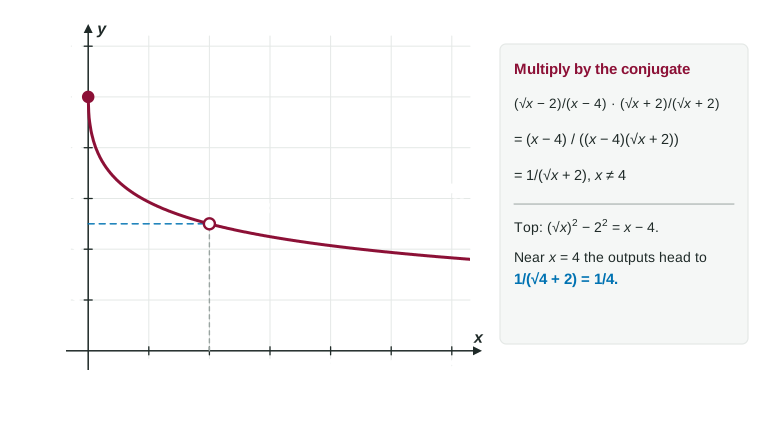
Worked example 2. Simplify for .
Notice the bottom was not multiplied out. Leaving it as is what makes the factor visible for canceling.
Near , the simplified form heads to .
Complex fractions
A complex fraction has fractions inside its numerator or denominator. Combine the small fractions over a common denominator first, then divide.
Worked example 3. Simplify for .
Top, over the common denominator :
Divide by , which is the same as multiplying by :
Near , this heads to .
Expanding powers
Limits often contain expressions like . Expand every power completely before simplifying:
Forgetting the middle term, , is the classic slip; is never . For a cube,
In every one of these moves, the goal is the same: produce a factor that matches the troublesome one in the denominator, so it can cancel. The next topic puts these moves to work on limits.