Skills Beta
Algebra for Limits: Factoring and Rationalizing
Limits that give zero over zero are settled with precalculus algebra: factor and cancel a common factor, multiply by a conjugate to clear a square root, or combine a complex fraction into one.
Practice 1: Implementing Mathematical Processes
Question set for this topic
Part 1 · Hook
Why this matters
The most common
limit on the exam looks impossible at first: substitute, and the top and bottom are both zero. The way through is algebra you already know from precalculus:
factoring, multiplying by a
conjugate, combining fractions. This page sharpens exactly those moves, in the form calculus will ask for them.
Part 2 · Before you start
What this builds on
Part 3 · Prerequisite check
Quick check before you start
1. Direct substitution gives
- it does not exist
Show the answer
A polynomial: substitute, .
- Correct: :
- :
- :
- it does not exist:
2. Which expression equals ?
Show the answer
; a reciprocal flips the sign of the exponent.
- Correct: :
- :
- :
- :
Part 5 · Step by step
How it works, step by step
- A fraction has a factor that is 0 at in both top and bottom→factor top and bottom so that factor is visible
- Canceling the common factor→gives a simpler expression equal to the original for every
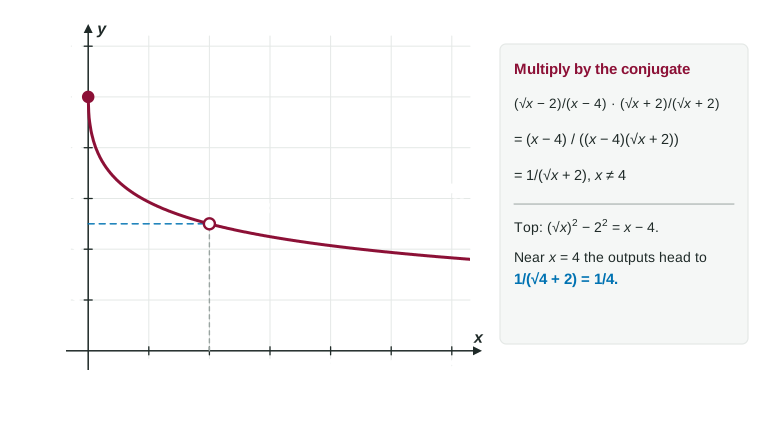
- A square root sits next to a number, as in →multiplying by the conjugate turns it into , which can cancel
- Fractions inside a fraction→a common denominator turns the complex fraction into one fraction you can simplify
Part 6 · Key ideas
Key ideas
- Factoring toolkit: common factor; difference of squares ; trinomials (with the method when the leading coefficient is not 1); cubes .
- Cancel factors, never terms: , but does not simplify.
- Rationalizing: multiply top and bottom by the conjugate ( and form a pair). Their product is . Leave the other factor unmultiplied.
- A complex fraction becomes one fraction with a common denominator; then divide.
- Expand powers fully: . The middle term is the one that matters.
Part 7 · Misconception
A common mistake
The wrong idea: , canceling the terms.
What actually happens: Only factors cancel. Factor first: . Test a number to catch the error: at the original is , not .
Part 8 · Check yourself
Check yourself
Exam-style questions. Anything you miss goes into your review queue.
1. Which is the factored form of ?
Show the answer
Check by expanding: . (Method: ; the factors 6 and add to 5, so split as and group.)
- Correct: : Expands back to .
- : This expands to : the signs are reversed.
- : This expands to .
- : This expands to : the leading coefficient 2 was lost.
2. Simplify for and .
Show the answer
Factor both: . Cancel the common factor : .
- Correct: : The common factor is .
- : That factors the bottom as , which expands to . The bottom is .
- : Canceling terms is not allowed: only factors cancel, never terms.
- : That factors the bottom as . The bottom is .
3. Which fraction can be simplified by canceling a common factor?
Show the answer
shares the factor with the bottom, so it simplifies to .
- Correct: : A difference of squares has the factor .
- : does not factor over the real numbers, so nothing cancels.
- : The 3s are inside sums, not factors; does not simplify.
- : has no factor : at it equals 12, not 0.
4. What is ?
Show the answer
A conjugate pair multiplies to a difference of squares: . The middle terms cancel.
- Correct: : .
- : That subtracts 3 instead of .
- : The 9 is subtracted, not added: .
- : The cross terms and cancel.
5. Simplify the complex fraction for and .
Show the answer
Common denominator on top: . Dividing by cancels the : .
- Correct: : Top: ; divide by .
- : : the minus sign must be distributed.
- : That is only the numerator; it must still be divided by .
- : The common denominator is ; the 2 cannot be dropped.
6. Simplify for .
Show the answer
Expand: . Divide by : .
- Correct: : .
- : That uses , missing the middle term .
- : Dividing by gives , not .
- : The 9s cancel; nothing leaves a 9.
7. A student simplifies: . What went wrong?
- The terms were canceled, but only factors can cancel; correctly, .
- Nothing: the result is correct.
- The student should have canceled instead: .
- The negatives should not cancel, so the answer is .
Show the answer
Canceling works on factors (things multiplied), not on terms (things added). Factor first: and . Then cancel .
- Correct: The terms were canceled, but only factors can cancel; correctly, .: Factor, then cancel the common factor .
- Nothing: the result is correct.: Test : , but .
- The student should have canceled instead: .: is a factor of the top only, not of .
- The negatives should not cancel, so the answer is .: The real error is canceling terms; the signs are not the issue.
Part 9 · Summary
Summary
Limits that give zero over zero are settled with precalculus algebra: factor and cancel a common factor, multiply by a conjugate to clear a square root, or combine a complex fraction into one. Cancel factors, never terms, and expand powers in full. The simplified expression agrees with the original everywhere except the troublesome point.
Part 10 · Up next
What comes next
Part 11 · Connections
Connections