Limits by Algebra: Factor, Rationalize, Simplify
When direct substitution gives the indeterminate form 0/0 , rewrite: factor and cancel, multiply by a conjugate, or simplify a complex fraction.
Part 1 · Hook
Why this matters
Part 2 · Before you start
What this builds on
Part 3 · Prerequisite check
Quick check before you start
1. Which is the factored form of ?
Show the answer
A difference of squares.
- Correct: :
- :
- :
- :
2. When can (polynomials) be found by direct substitution?
- When
- When
- Always
- When
Show the answer
The quotient law needs a nonzero denominator.
- Correct: When :
- When :
- Always:
- When :
3. What is ?
Show the answer
A conjugate pair: .
- Correct: :
- :
- :
- :
Part 4 · See it
See it first
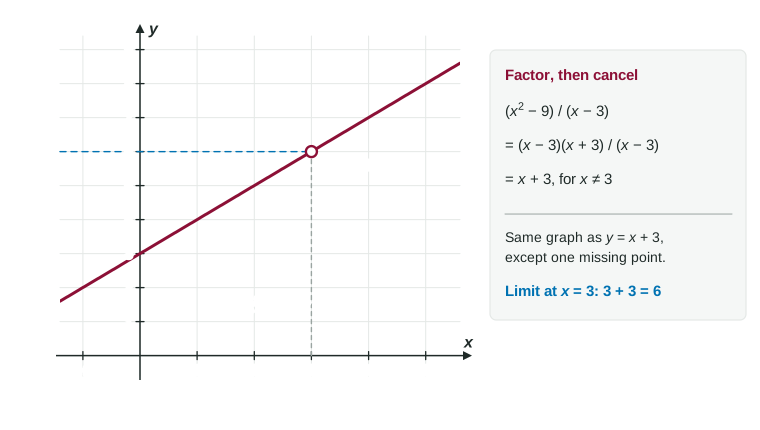
Part 5 · Step by step
How it works, step by step
- Direct substitution gives an indeterminate form: the limit is not yet known
- Top and bottom are both 0 at they share a factor (for polynomials), possibly hidden behind a square root or a fraction
- Factor, rationalize or combine fractions, then cancel the shared factorthe new expression equals the old one for every , so it has the same limit
- Substitute into the simplified expressionthe limit appears (or a nonzero over zero shows there is no finite limit)
Part 6 · Key ideas
Key ideas
- is an indeterminate form: it means "rewrite first", never 0, 1 or "does not exist".
- Canceling is legal in a limit because the limit never uses , and for the canceled factor is not 0.
- Toolkit: factor and cancel; multiply by a conjugate to clear a square root; combine a complex fraction; expand powers completely.
- After simplifying, a nonzero number over 0 means no finite limit (unbounded); check one-sided signs if asked.
- Keep "" on every line until you substitute; never write .
Part 7 · Misconception
A common mistake
The wrong idea: Substitution gives , so the limit is 0 (or does not exist).
What actually happens: is indeterminate: it gives no information about the limit. Rewrite the expression;
Part 8 · Check yourself
Check yourself
Exam-style questions. Anything you miss goes into your review queue.
Graph
The graph of
1. Factor to find the exact value of .
No calculator. Type the exact value (a fraction, π, e or a root is fine).
Show the answer
- Answer: ≈ 1.250
2. Substituting into gives . What does that tell you?
- Not yet determined; rewrite and try again.
- The limit is 0, because the numerator is 0.
- The limit does not exist, because the denominator is 0.
- The limit is 1, because the top and bottom are equal.
Show the answer
is an indeterminate form: the limit could be any number or might not exist. It is a signal to factor, rationalize or simplify. Here factoring gives .
- Correct: Not yet determined; rewrite and try again.: Not yet determined; rewrite.
- The limit is 0, because the numerator is 0.: A zero numerator alone settles nothing when the denominator also heads to 0.
- The limit does not exist, because the denominator is 0.: A zero denominator alone settles nothing when the numerator also heads to 0.
- The limit is 1, because the top and bottom are equal.: is not 1; zero over zero has no value.
3. What can you conclude about ?
- No finite limit: the top heads to , the bottom to 0.
- It equals , found by factoring and then substituting .
- It equals 0, because makes the denominator of equal to 0.
- It equals , the value of at .
Show the answer
At the numerator is , not 0, while the denominator heads to 0. A nonzero number over a number near 0 is unbounded, as the vertical asymptote shows.
- Correct: No finite limit: the top heads to , the bottom to 0.: over a quantity near 0 is unbounded.
- It equals , found by factoring and then substituting .: After canceling, still has a zero denominator at .
- It equals 0, because makes the denominator of equal to 0.: A denominator near 0 makes the quotient large in size, not 0.
- It equals , the value of at .: The simplified form is , not .
4. Which line of work is written correctly?
Show the answer
Each "=" joins equal things, and "lim" stays on every line until the number appears.
- Correct:
: Every equals sign is true. : is false: "=" links unequal things. : The limit (a number) is set equal to an expression in in the middle step; keep "lim" until you substitute. : The terms were canceled; only factors can cancel.
5. Find .
No calculator. Type the exact value (a fraction, π, e or a root is fine).
Show the answer
- Answer: -1
6. Find .
No calculator. Type the exact value (a fraction, π, e or a root is fine).
Show the answer
- Answer: 8
7. What is ?
- It does not exist: from the left, from the right.
- , because near the top and bottom have equal sizes, so they cancel.
- , because the top becomes 0.
- , because is negative.
Show the answer
For , , so the quotient is 1. For , , so the quotient is . The one-sided limits differ.
- Correct: It does not exist: from the left, from the right.: Left , right .
- , because near the top and bottom have equal sizes, so they cancel.: Only for ; to the left the quotient is .
- , because the top becomes 0.: The bottom also heads to 0.
- , because is negative.: Only for .
Part 9 · Summary
Summary
Part 10 · Up next
What comes next
Part 11 · Connections