Choosing a Way to Find a Limit
Substitute first and read the result.
Part 1 · Hook
Why this matters
Part 2 · Before you start
What this builds on
Part 3 · Prerequisite check
Quick check before you start
1. Which is the factored form of ?
Show the answer
- Correct: :
- :
- :
- :
2. If and , then
- does not exist
- equals 3
- equals 5
- equals 1
Show the answer
A two-sided limit exists only when the one-sided limits are equal.
- Correct: does not exist:
- equals 3:
- equals 5:
- equals 1:
3. For a polynomial , is
- not known without a graph
Show the answer
The limit laws give direct substitution for polynomials.
- Correct: :
- :
- :
- not known without a graph:
Part 4 · See it
See it first
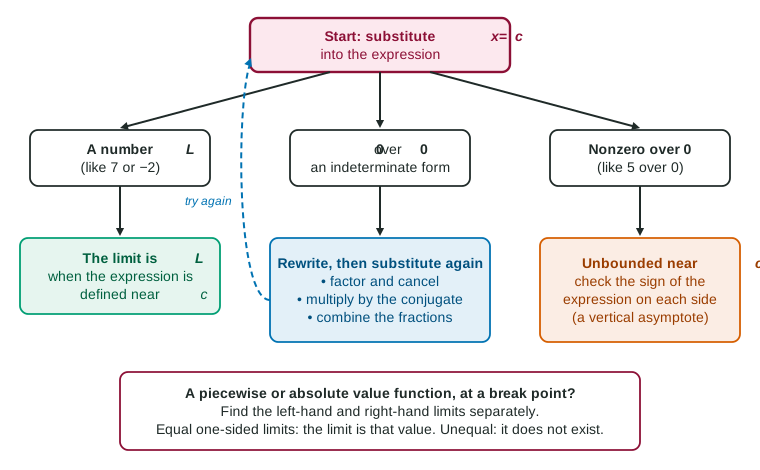
Part 5 · Step by step
How it works, step by step
- You substitute and get a numberthat number is the limit, as long as the expression is defined near
- You get the numerator and denominator share a hidden zero factor, so rewrite (factor, conjugate, common denominator) and substitute again
- You get a nonzero number over 0the denominator shrinks while the numerator does not, so the function is unbounded near and the limit does not exist
- The function changes formula at (piecewise or absolute value)find the left-hand and right-hand limits separately; equal means the limit exists
Part 6 · Key ideas
Key ideas
- Substitute first. It is the fastest test, and its result tells you what to do next.
- is an indeterminate form: not an answer, a signal to rewrite.
- A nonzero number over 0 means the function is unbounded near ; no algebra will make the limit a number.
- At a break point, the two sides can follow different rules. Find both one-sided limits.
- Write the limit symbol on every line until you substitute: the simplified expression equals the original only for .
Part 7 · Misconception
A common mistake
The wrong idea: Substituting gives , so the limit does not exist.
What actually happens: is indeterminate: the limit may be any number or may not exist. Rewrite the expression and substitute again. For the limit is 6.
Part 8 · Check yourself
Check yourself
Exam-style questions. Anything you miss goes into your review queue.
Table
Four functions near
| Function | Formula |
|---|---|
1. Substituting into which function gives a nonzero number divided by ?
Show the answer
At , gives : a nonzero numerator over a zero denominator.
- Correct: : would be , so is unbounded near 3.
- : gives , an indeterminate form, not a nonzero number over 0.
- : gives , an indeterminate form.
- : gives ; its denominator is not 0 at .
2. Find .
No calculator. Type the exact value (a fraction, π, e or a root is fine).
Show the answer
Substitution gives , so factor:
- Answer: 1
3. What can you conclude about ?
- It equals , the value of the numerator at
- It does not exist; is unbounded near
- It equals , after the terms cancel
- It can be found by factoring and cancelling first
Show the answer
A nonzero number over 0 means the denominator shrinks while the numerator stays near 6, so grows without bound. Left of 3, is very negative; right of 3, very positive. The limit does not exist.
- It equals , the value of the numerator at : The numerator's value alone ignores the denominator, which is heading to 0.
- Correct: It does not exist; is unbounded near : Near 3 the numerator is about 6 and the denominator is tiny, so is unbounded and the limit does not exist.
- It equals , after the terms cancel: Nothing cancels: and are different factors.
- It can be found by factoring and cancelling first: Factoring helps with . Here the numerator is not 0 at , so there is no common factor to cancel.
4. Let . Which is true about ?
- It equals , because is not negative for any
- It equals , because the numerator approaches
- It does not exist, because grows without bound near
- It does not exist; is on the left, on the right
Show the answer
For , and . For , and . The one-sided limits, and , differ, so the limit does not exist.
- It equals , because is not negative for any : The numerator is not negative, but the denominator is negative left of 5, which makes there.
- It equals , because the numerator approaches : Both numerator and denominator approach 0; that is , which needs more work, not the answer 0.
- It does not exist, because grows without bound near : The limit does fail to exist, but not by growing: only takes the values and .
- Correct: It does not exist; is on the left, on the right: Split at the break: for and for . Unequal one-sided limits, so no limit.
5. A student writes: ": substituting gives , so the limit does not exist." Which correction is right?
- Rewrite: , so the limit is 2
- equals 1, so the limit of the quotient is 1
- equals 0, so the limit of the quotient is 0
- It does not exist, but because of a jump at
Show the answer
is an indeterminate form: it tells you nothing yet. Here
- Correct: Rewrite: , so the limit is 2: Factor and cancel: . Writing "" would be wrong too; the 2 comes from the rewritten expression.
- equals 1, so the limit of the quotient is 1: is not a number. Treating it as 1 skips the rewriting step.
- equals 0, so the limit of the quotient is 0: is not 0. A zero numerator only gives 0 when the denominator is not also 0.
- It does not exist, but because of a jump at : The expression equals on both sides of 1, so there is no jump and the limit exists.
6. Find .
No calculator. Type the exact value (a fraction, π, e or a root is fine).
Show the answer
Both parts are 0 at . Factor:
- Answer: ≈ -0.500
Part 9 · Summary
Summary
Part 10 · Up next
What comes next
Part 11 · Connections