Unit 1 · Topic 1.6 Beta

Limits by Algebra: Factor, Rationalize, Simplify

5 min read · freeNot practiced

Try direct substitution on limx→3x2−9x−3\lim_{x \to 3} \frac{x^2 - 9}{x - 3} and you get 00\frac{0}{0}. This is not a broken problem. It is the most important kind of limit in the course, because every rate at an instant in Unit 2 begins exactly this way: a change in output over a change in input, both shrinking to 0. This page shows what 00\frac{0}{0} means and the algebra that gets past it.

What 00\frac{0}{0} means

When substitution makes both the numerator and the denominator 0, the result 00\frac{0}{0} is called an indeterminate form. "Indeterminate" means the limit is not determined yet. Depending on the function, the true limit could be 6, or −116-\frac{1}{16}, or it might not exist. These three limits all start as 00\frac{0}{0}:

LimitSubstitution givesActual limit
limx→3x2−9x−3\lim_{x \to 3} \frac{x^2 - 9}{x - 3}00\frac{0}{0}6
limx→0x2x\lim_{x \to 0} \frac{x^2}{x}00\frac{0}{0}0
limx→0xx2\lim_{x \to 0} \frac{x}{x^2}00\frac{0}{0}does not exist

So 00\frac{0}{0} is never an answer: not 0, not 1, not "does not exist." It is an instruction: rewrite the expression and try again.

Compare a different result: substitution gives a nonzero number over 0, such as −40\frac{-4}{0}. That one is not indeterminate. The outputs are unbounded, and there is no finite limit.

Why canceling is allowed

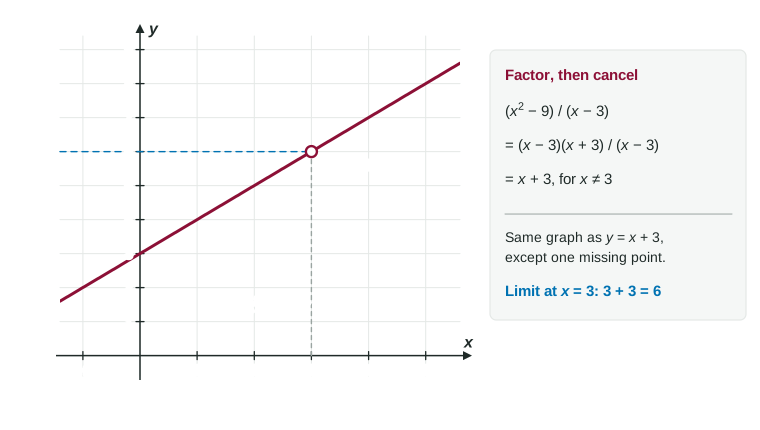
The graph of y = (x squared minus 9) over (x minus 3) is the line y = x + 3 with an open circle at (3, 6). A panel shows the algebra: factor x squared minus 9 as (x - 3)(x + 3), cancel x - 3 for x not equal to 3, and get x + 3, so the limit at x = 3 is 6.
Figure 1. x2−9x−3\frac{x^2 - 9}{x - 3} and x+3x + 3 have the same graph, except that the first has a hole at x=3x = 3. LevlPrep original diagram.

For every x≠3x \ne 3, x2−9x−3\frac{x^2 - 9}{x - 3}=(x−3)(x+3)x−3= \frac{(x - 3)(x + 3)}{x - 3}=x= x+3+ 3, because the factor x−3x - 3 is not zero and can be divided out. The two functions differ only at x=3x = 3, where the first is undefined. A limit never looks at x=3x = 3 itself, so the two functions have the same limit there: limx→3x2−9x−3=limx→3(x+3)=6\lim_{x \to 3} \frac{x^2 - 9}{x - 3} = \lim_{x \to 3} (x + 3) = 6 That is the whole strategy: rewrite into a function that agrees everywhere except at aa, then substitute.

Strategy 1: factor and cancel

If a polynomial is 0 at x=ax = a, it has a factor x−ax - a. So when both top and bottom are 0 at aa, they share that factor.

Worked example 1. Find limx→2x2+x−6x2−4\lim_{x \to 2} \frac{x^2 + x - 6}{x^2 - 4}.

Substitution: 4+2−64−4\frac{4 + 2 - 6}{4 - 4}=00= \frac{0}{0}. Indeterminate, so factor.

limx→2x2+x−6x2−4=limx→2(x+3)(x−2)(x+2)(x−2)=limx→2x+3x+2=54\lim_{x \to 2} \frac{x^2 + x - 6}{x^2 - 4} = \lim_{x \to 2} \frac{(x + 3)(x - 2)}{(x + 2)(x - 2)} = \lim_{x \to 2} \frac{x + 3}{x + 2} = \frac{5}{4}

Worked example 2. Find limx→2x3−8x−2\lim_{x \to 2} \frac{x^3 - 8}{x - 2}.

Difference of cubes: x3−8x^3 - 8=(x−2)(x2+2x+4)= (x - 2)(x^2 + 2x + 4).

limx→2(x−2)(x2+2x+4)x−2=limx→2(x2+2x+4)=4+4+4=12\lim_{x \to 2} \frac{(x - 2)(x^2 + 2x + 4)}{x - 2} = \lim_{x \to 2} (x^2 + 2x + 4) = 4 + 4 + 4 = 12

Strategy 2: rationalize

When a square root is involved, multiply the top and bottom by the conjugate. The square root disappears and a common factor appears.

Worked example 3. Find limx→0x+9−3x\lim_{x \to 0} \frac{\sqrt{x + 9} - 3}{x}.

Substitution gives 00\frac{0}{0}. Multiply by x+9+3x+9+3\frac{\sqrt{x + 9} + 3}{\sqrt{x + 9} + 3}:

limx→0(x+9)−9x(x+9+3)=limx→0xx(x+9+3)=limx→01x+9+3=16\lim_{x \to 0} \frac{(x + 9) - 9}{x(\sqrt{x + 9} + 3)} = \lim_{x \to 0} \frac{x}{x(\sqrt{x + 9} + 3)} = \lim_{x \to 0} \frac{1}{\sqrt{x + 9} + 3} = \frac{1}{6}

Leave the denominator in factored form; multiplying it out hides the xx you need to cancel.

Strategy 3: combine fractions, or expand

Worked example 4. Find limh→012+h−12h\lim_{h \to 0} \frac{\frac{1}{2 + h} - \frac{1}{2}}{h}.

Combine the top over 2(2+h)2(2 + h): 2−(2+h)2(2+h)\frac{2 - (2 + h)}{2(2 + h)}=−h2(2+h)= \frac{-h}{2(2 + h)}.

limh→0−h2(2+h)⋅1h=limh→0−12(2+h)=−14\lim_{h \to 0} \frac{-h}{2(2 + h)} \cdot \frac{1}{h} = \lim_{h \to 0} \frac{-1}{2(2 + h)} = -\frac{1}{4}

Worked example 5. Find limh→0(3+h)2−9h\lim_{h \to 0} \frac{(3 + h)^2 - 9}{h}.

Expand: (3+h)2−9(3 + h)^2 - 9=6h+h2= 6h + h^2=h(6+h)= h(6 + h).

limh→0h(6+h)h=limh→0(6+h)=6\lim_{h \to 0} \frac{h(6 + h)}{h} = \lim_{h \to 0} (6 + h) = 6

This is the same calculation as the falling stone in Topic 1.1, now in limit notation.

When the simplified form still has a zero denominator

After canceling, substitute again. If the denominator is still 0 but the numerator is not, there is no finite limit. For example, x2−25x2−10x+25\frac{x^2 - 25}{x^2 - 10x + 25}=(x−5)(x+5)(x−5)2= \frac{(x - 5)(x + 5)}{(x - 5)^2}=x+5x−5= \frac{x + 5}{x - 5}, and at x=5x = 5 that is 100\frac{10}{0}: unbounded, so the limit does not exist.

Absolute values call for one-sided limits. |x−3|x−3\frac{|x - 3|}{x - 3} equals 1 for x>3x > 3 and −1-1 for x<3x < 3, so limx→3|x−3|x−3\lim_{x \to 3} \frac{|x - 3|}{x - 3} does not exist.

Writing the work

Loses creditEarns credit
x2−9x−3\frac{x^2 - 9}{x - 3}=00= \frac{0}{0}=6= 6limx→3x2−9x−3\lim_{x \to 3} \frac{x^2 - 9}{x - 3}=limx→3(x+3)= \lim_{x \to 3} (x + 3)=6= 6
limx→3x2−9x−3\lim_{x \to 3} \frac{x^2 - 9}{x - 3}=x= x+3+ 3=6= 6keep "limx→3\lim_{x \to 3}" until the line where you substitute

The equals sign may only join things that are equal. A limit is a number, x+3x + 3 is an expression, and 00\frac{0}{0} is not a number at all, so none of them can be chained with the others.
Spot a mistake on this page?