When substitution gives a nonzero number over 0, you already know the function is unbounded near that point. This topic gives that behavior its notation, shows how to find which way the function heads on each side, and connects it to vertical asymptotes.
What an infinite limit says
Look at near 2. At it is 100; at it is 10,000; at it is 1,000,000. The same happens from the left. The values do not settle on any number. They grow beyond every bound. We write
Read it as " increases without bound as approaches 2." This is an infinite limit. Be careful about what it means: is not a number, so the limit does not exist. The notation tells you how it fails to exist. In the same way, means the values decrease without bound.
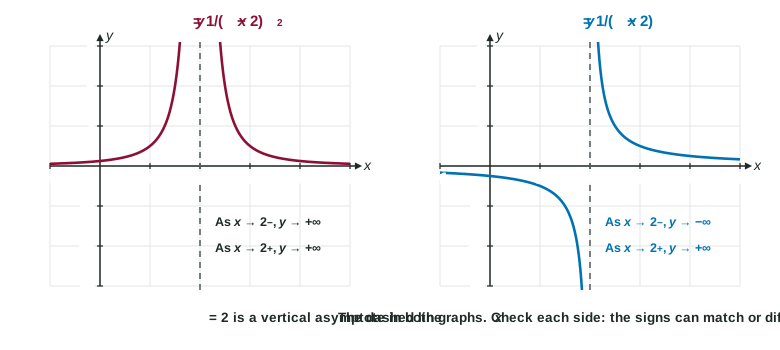
Finding the sign on each side
When substitution gives a nonzero number over 0, the size of the quotient blows up. Its sign on each side decides between and . Work it out from the signs of the pieces.
Worked example 1. Find and .
Near 3 the numerator is close to 4, which is positive.
Left of 3 (say ): is a tiny negative number. Positive over tiny negative is hugely negative, so
Right of 3 (say ): is a tiny positive number, so
The sides disagree, so the two-sided limit does not exist and is not or either. Report the one-sided limits.
A squared factor such as is positive on both sides, so it never changes sign. That is why goes up on both sides.
Worked example 2. Find .
The numerator approaches . The denominator is a tiny positive number on both sides. Negative over tiny positive is hugely negative on both sides, so the limit is .
Vertical asymptotes
The line is a vertical asymptote of the graph of when at least one of and is or . One side is enough. The graph of , for instance, has the asymptote with only a right side: .
For a rational function, factor and cancel first. A factor that cancels gives a hole; a factor that stays in the denominator gives an asymptote.
Worked example 3. Find the vertical asymptotes of
Factor:
At the factor cancels:
At the numerator approaches 2 and the denominator approaches 0, so is unbounded. The only vertical asymptote is .
Other functions have asymptotes too. has one wherever , such as , with
Writing it correctly
- Write , never . A function's value is a number or undefined.
- Write only when both sides go to . If the sides differ, give them separately.
- To justify an asymptote, show an infinite one-sided limit. "The denominator is 0" is not enough, because a hole also has a zero denominator.