Infinite Limits and Vertical Asymptotes
An infinite limit, lim as x → c, f(x) = ±∞ , says f grows without bound near c ; the limit does not exist as a number.
Part 1 · Hook
Why this matters
Part 2 · Before you start
What this builds on
Part 3 · Prerequisite check
Quick check before you start
1. Substituting into gives . Near 4, the expression
- is unbounded
- is close to 5
- is close to 0
- is close to 1
Show the answer
A nonzero number over a shrinking denominator grows without bound.
- Correct: is unbounded:
- is close to 5:
- is close to 0:
- is close to 1:
2. An infinite discontinuity at means the graph has
- a vertical asymptote
- a hole at
- a jump at
- a horizontal asymptote
Show the answer
An infinite discontinuity is unbounded behavior near c.
- Correct: a vertical asymptote :
- a hole at :
- a jump at :
- a horizontal asymptote:
Part 4 · See it
See it first
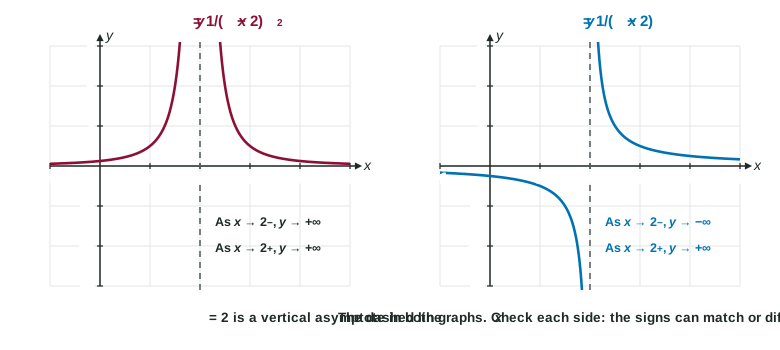
Part 5 · Step by step
How it works, step by step
- As , the denominator shrinks to 0 while the numerator approaches a nonzero numberthe quotient grows without bound in size
- The sign of the quotient on each side of is found from the signs of its factorseach one-sided limit is or
- At least one one-sided limit at is infinitethe line is a vertical asymptote
- is not a number describes how the limit fails to exist; never write
Part 6 · Key ideas
Key ideas
- means grows beyond every bound as nears . It is an infinite limit: the limit does not exist, and this says how.
- Find each side by signs: a nonzero numerator over a denominator approaching 0 from the positive or negative side.
- If the two sides agree, write (or ). If they disagree, give each one-sided limit.
- is a vertical asymptote when at least one one-sided limit at is or .
- For a rational function, cancel common factors first: a canceled factor gives a hole, a factor left in the denominator gives an asymptote.
Part 7 · Misconception
A common mistake
The wrong idea:
What actually happens: is not a number. An infinite limit is a limit that does not exist, described precisely: the values grow without bound. On a justification, say "unbounded" or "grows without bound", and never write .
Part 8 · Check yourself
Check yourself
Exam-style questions. Anything you miss goes into your review queue.
Table
A rational function
| Form | Formula |
|---|---|
| Given | |
| Factored |
1. Which lines are vertical asymptotes of the graph of ?
- The line , and no other
- The lines and
- The line , and no other
- No line; has no vertical asymptote
Show the answer
The factor cancels, so for : a hole at . The factor stays in the denominator, so is unbounded near 2.
- Correct: The line , and no other: remains in the denominator after cancelling; does not.
- The lines and : At the zero factor cancels, leaving a hole, not an asymptote.
- The line , and no other: is a hole. The asymptote is where the uncanceled factor is 0.
- No line; has no vertical asymptote: Near , grows without bound.
2. Find .
Show the answer
Near 2, . For slightly less than 2, is a tiny negative number, so is a huge negative number: .
- : That is the right-hand limit, where .
- Correct: : Positive 1 over a tiny negative number is very negative.
- : The numerator is 1, not 0, while the denominator shrinks.
- : is the height of the hole at .
3. Which statement about is correct?
- , because is unbounded on both sides of 2
- , because has a numerator of 1
- It does not exist; the sides go to and
- It exists, because both one-sided limits are infinite in the same way
Show the answer
and . The sides head in opposite directions, so not even or describes the two-sided behavior.
- , because is unbounded on both sides of 2: Writing for the two-sided limit needs both sides to go to ; here the left goes to .
- , because has a numerator of 1: A fixed numerator over a shrinking denominator grows without bound.
- Correct: It does not exist; the sides go to and : Opposite signs on the two sides: describe each side separately.
- It exists, because both one-sided limits are infinite in the same way: They are infinite in opposite directions; and an infinite limit is never a number anyway.
4. Find .
Show the answer
As , the numerator approaches 4 (positive) and is a tiny negative number. Positive over tiny negative: .
- : Check the sign of for just above 3: it is negative.
- : is the ratio of the coefficients, which describes behavior far from 3, not near it.
- Correct: : makes negative.
- : 4 is the numerator's limit; the denominator heads to 0.
5. What are the vertical asymptotes of
- and
- , and no other line
- , and no other
- and
Show the answer
- and : At the factor cancels, so : a hole.
- , and no other line: is the hole; the asymptote is .
- Correct: , and no other: Only the uncanceled factor gives an asymptote.
- and : makes the numerator 0, which gives a zero of .
6. Which statement justifies that is a vertical asymptote of ?
- is undefined
- The denominator of is 0 when
Show the answer
A vertical asymptote is defined by an infinite one-sided limit at . Here
- is undefined: Undefined points can be holes; that alone does not show an asymptote.
- The denominator of is 0 when : A zero denominator can come with a zero numerator and a hole; the limit must be shown infinite.
: This is about the denominator only, not about the behavior of . - Correct: : One infinite one-sided limit is exactly what a vertical asymptote means.
7. A student says: "
- It does not exist; describes how the values grow
- It exists, because both sides of 2 agree on the value
- It exists, but just from the right side of
- It does not exist, because the two sides go in opposite ways
Show the answer
is not a real number, so an infinite limit is a limit that does not exist. Writing adds information: the values grow without bound in the positive direction on both sides.
- Correct: It does not exist; describes how the values grow: "Equals infinity" is notation for a specific way of not existing.
- It exists, because both sides of 2 agree on the value : Both sides do agree in direction, which is why we may write ; but is not a value.
- It exists, but just from the right side of : Both one-sided limits behave the same way; neither is a number.
- It does not exist, because the two sides go in opposite ways: on both sides, so both sides go up.
Part 9 · Summary
Summary
Part 10 · Up next
What comes next
Part 11 · Connections