In the last topic, the average speeds of a falling stone over shorter and shorter intervals closed in on 32 feet per second: 48, 40, 33.6, 32.16, 32.016. We kept saying "closes in on." Calculus gives that phrase a name, the limit, and a notation that you will write thousands of times this year. This page is about what a limit means and how to write it so that it earns credit.
What a limit says
Take a function and a number . Let get closer and closer to , from both sides, without ever being equal to . Watch the outputs . If they close in on one number , as close as you like, then is the limit of as approaches . We write and read it as "the limit of of , as approaches , equals ."
Three parts, each with a job:
- "lim" says we are asking about a trend, not a single value.
- "" underneath says where the input is heading.
- "" says where the outputs are heading.
Worked example 1. Write the falling-stone result from Topic 1.1 in limit notation.
The average speed over was feet per second, and we let shrink toward 0. So the input is , heading to 0:
In words: as the interval length approaches 0, the average speed approaches 32 feet per second. That limit is the speed at the instant .
The value at the point does not matter
This is the most important fact about limits, and the most surprising. The definition never lets equal . So the limit cannot depend on .
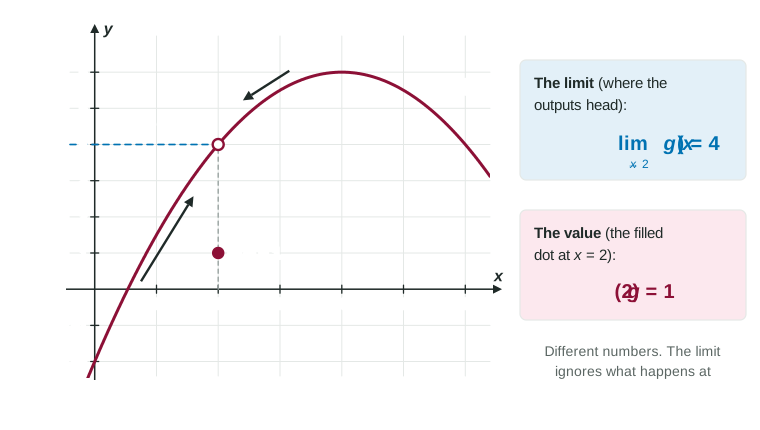
In the figure, the curve heads to the open circle at from both sides, so . The function's actual value at 2 is the filled dot: . Both statements are true at once. Three situations come up again and again:
| At the graph has | ||
|---|---|---|
| an unbroken curve through | (they agree) | |
| a hole at and a dot at | ||
| a hole at and no dot | not defined |
Why build calculus on an idea that ignores the point itself? Because of Topic 1.1. At the instant , the average-speed formula is zero divided by zero: it has no value at all. The limit is exactly the tool that looks at nearby inputs and never at the problem point.
Three ways to find a limit
A limit can be read from three kinds of information, and the next topics teach each one:
- A graph (Topic 1.3): follow the heights as slides toward from the left and from the right.
- A table (Topic 1.4): look at outputs for inputs like 1.9, 1.99, 1.999 and 2.1, 2.01, 2.001.
- A formula (Topics 1.5 and 1.6): use rules and algebra to find the limit exactly.
Sometimes the outputs do not close in on a single number. The two sides might head to different heights, or the outputs might grow without stopping. Then there is no limit; Topic 1.3 shows how to recognize each case.
Reading limits in context
When the function describes something real, a limit statement becomes a sentence about a trend. If is the volume of water in a tank, in liters, hours after noon, then means: as the time gets closer and closer to 3 p.m., the volume of water gets closer and closer to 12 liters. A careful interpretation names the quantity, its units and the input it approaches. It does not claim that , because the limit statement alone does not say that.
Writing limits the way readers expect
On free-response questions, the notation is part of the answer. Habits that keep your work correct:
- Keep "" in front of the expression on every line until the line where you actually get a number. Then drop it.
- Put parentheses around a sum or difference after "lim": "" is ambiguous, while "
" is clear. - Use the equals sign only between things that are equal. Writing when you mean is a different, and often false, statement.
- Name the function: "", not "the limit is 4."
Worked example 2. A graph of heads to height 6 from both sides as approaches 3, and has a filled dot at . Write what you know.
Limit: . Value: .
So . Writing "" would be wrong.