Checking three conditions at one point is fine for one point. But the big theorems ahead ask whether a function is continuous on a whole interval, which contains infinitely many points. This page shows how to answer that quickly: know which functions are continuous where, and check only the few places where something can go wrong.
Continuous on an interval
A function is continuous on an open interval when it is continuous at every point of it. On a closed interval there is one extra detail. At the endpoints, the function may not even be defined outside the interval, so we ask only about the side inside it:
- at the left endpoint :
(continuous from the right); - at the right endpoint :
(continuous from the left).
So is continuous on : there is nothing to the left of 0, but
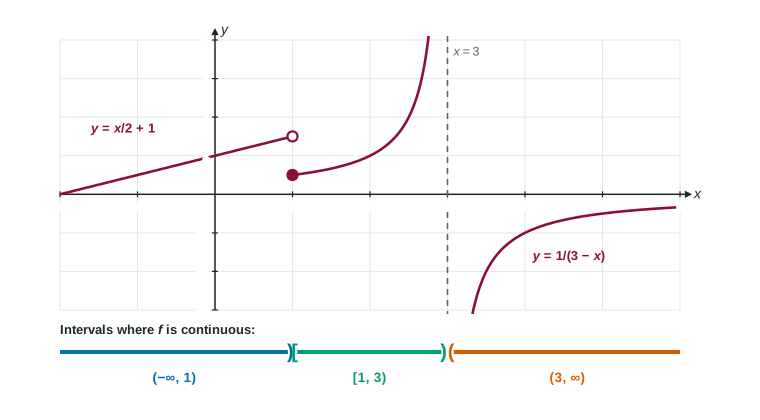
In the figure, jumps at , but the closed dot belongs to the right piece. So is continuous from the right at 1, and the middle interval can include 1: it is . It cannot include 3, where is undefined.
Functions that are continuous on their domains
You do not have to check every point by hand. These families are continuous at every point where they are defined:
| Family | Example | Continuous on |
|---|---|---|
| polynomials | ||
| rational functions | every where the denominator is not 0 | |
| roots | where the radicand is (even roots) | |
| exponentials | , | |
| logarithms | ||
| sine and cosine | , | |
| tangent | wherever , such as |
Combinations keep continuity. Sums, differences and products of continuous functions are continuous. A quotient is continuous wherever its denominator is not 0. A composition is continuous wherever is continuous and is continuous at the value .
Finding where a function is continuous
Worked example 1. Where is
needs , so ; there it is continuous.
is continuous except at .
The sum is continuous where both parts are: on and on .
Worked example 2. Let for and for . Where is continuous?
Each piece is continuous on its own interval ( and are continuous everywhere). The only question is the break point .
.
All three conditions hold at 0, so is continuous on .
A short procedure
- Identify each part of the function and its family.
- List the trouble spots: zeros of denominators, inputs where an even root or a logarithm is undefined, zeros of under a , and break points of piecewise rules.
- Away from the trouble spots, the function is continuous by the families and the combination rules.
- At each break point of a piecewise rule, check the three conditions.
- Write the answer as intervals, with a bracket at an endpoint only when the function is defined there and continuous from inside.
Why does this matter so much? The Unit 1 finale, and several theorems in later units, start with "if is continuous on ". To use them, you will name the reason is continuous on that closed interval, usually with a sentence from this page: " is a polynomial, so it is continuous on ."