Continuity on an Interval
A function is continuous on an interval when it is continuous at every point of it, with one-sided continuity at closed endpoints.
Part 1 · Hook
Why this matters
Part 2 · Before you start
What this builds on
Part 3 · Prerequisite check
Quick check before you start
1. is continuous at when
- is defined, exists, and they are equal
- is defined
- exists
Show the answer
All three conditions are needed.
- Correct: is defined, exists, and they are equal:
- is defined:
- exists:
- :
2. What is the domain of ?
- every real number
Show the answer
A logarithm is defined only for positive inputs.
- Correct: :
- :
- every real number:
- :
3. Where is undefined?
Show the answer
The denominator is 0 at x = 4.
- Correct: :
- :
- :
- :
Part 4 · See it
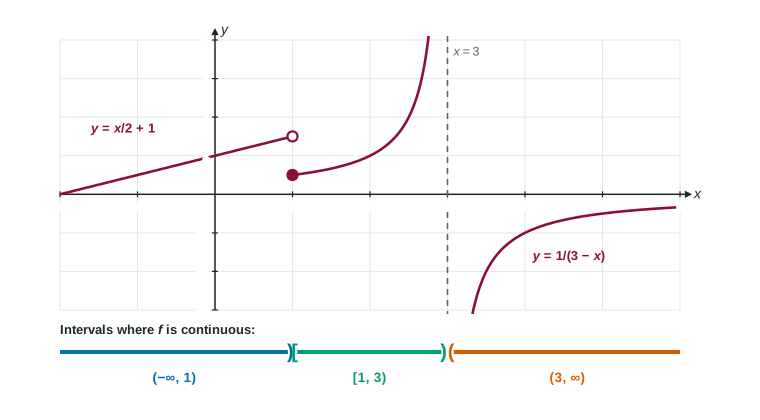
See it first
Part 5 · Step by step
How it works, step by step
- A function is continuous at every point of an open intervalit is continuous on that interval: its graph has no break there
- The interval is closed, at the endpoints only the one-sided limit from inside counts:
and - Polynomial, rational, root, exponential, logarithmic and trigonometric functionsare continuous on their domains, so you only check where they are undefined
- Continuous functions are combined by sums, products, quotients or compositionthe result is continuous wherever it is defined; only break points of piecewise rules need a separate check
Part 6 · Key ideas
Key ideas
- Continuous on an interval: continuous at every point of it. At a closed endpoint, only the one-sided limit from inside must match the value.
- Polynomials, , and are continuous on .
- Rational functions, roots, and are continuous on their domains: avoid zeros of denominators, negative inputs to even roots, inputs to that are not positive, and zeros of for .
- Sums, products, quotients (denominator not 0) and compositions of continuous functions are continuous.
- For a piecewise function, each piece is handled by the rules above; check each break point with the three conditions.
Part 7 · Misconception
A common mistake
The wrong idea: If is continuous on and on , it is continuous on .
What actually happens: Continuity on only guarantees continuity from the right at 5. The left-hand limit at 5 can still differ from , so may jump there. Check the shared point with all three conditions.
Part 8 · Check yourself
Check yourself
Exam-style questions. Anything you miss goes into your review queue.
Graph
The graph of on
1. On which of these intervals is continuous?
Show the answer
On the curve is unbroken. At the left endpoint 0, the right-hand limit is 3 and , so is continuous from the right there. That is all a closed left endpoint needs.
- Correct: : Unbroken inside, and
at the closed endpoint. - : At the right endpoint 0, the left-hand limit is 2 but , so is not continuous from the left there.
- : This interval contains the jump at in its interior.
- : is undefined, and 2 is inside this interval.
2. At , the function is continuous
- from the left, but not from the right
- from the right, but not from the left
- from both the left and the right
- from neither the left nor the right
Show the answer
- from the left, but not from the right: The left piece heads to the open circle at height 2, not to .
- Correct: from the right, but not from the left: The closed dot sits where the right piece starts.
- from both the left and the right: The left side arrives at 2, not at .
- from neither the left nor the right: From the right, the curve arrives exactly at .
Table
Four functions
| Function | Formula |
|---|---|
3. Which is the largest interval on which is continuous?
Show the answer
is defined for . At the endpoint 1,
- : This leaves out 1, where is continuous from the right. It is not the largest.
- : is not a real number.
- Correct: : Defined and continuous for , with one-sided continuity at 1.
- : is undefined for .
4. Let for and for . Where is continuous?
- On
- On and , not at 0
- On , and nowhere to the left of 0
- On , and nowhere to the right of 0
Show the answer
Each piece is continuous on its own interval. At 0: ,
- Correct: On : Both pieces are continuous, and they meet at , which is .
- On and , not at 0: and : the pieces meet, so 0 is not a break.
- On , and nowhere to the left of 0: is continuous for .
- On , and nowhere to the right of 0: is continuous for .
5. At how many real numbers is not continuous?
No calculator. Type the exact value (a fraction, π, e or a root is fine).
Show the answer
is a rational function, so it is continuous except where
- Answer: 3
6. A function is continuous on and on . Is continuous on ?
- Not necessarily: might differ from
- Yes: together the two intervals cover
- Yes: is defined because is in
- No: two touching intervals of continuity force a break at 5
Show the answer
Continuity on only says is continuous from the right at 5. Continuity at 5 also needs
- Correct: Not necessarily: might differ from : The left side at 5 is not covered by either fact, so a jump at 5 is possible.
- Yes: together the two intervals cover : Covering the points is not enough; the left-hand limit at 5 must match .
- Yes: is defined because is in : A defined value is one condition; the two-sided limit at 5 must equal it.
- No: two touching intervals of continuity force a break at 5: Two such intervals need not break; for example, is continuous on both intervals and on .
Part 9 · Summary
Summary
Part 10 · Up next
What comes next
Part 11 · Connections