The last three topics taught you to spot and classify breaks. Now you repair them. Exam questions phrase this two ways: "what value should be?" and "for what value of is continuous?" Both come down to one idea: the value at the point has to equal the limit there.
Filling a hole
A removable discontinuity has a limit, , but the value is missing or different. To remove it, define (or redefine) the function at to be . Then all three conditions hold: is defined, the limit exists, and they are equal.
Worked example 1. is undefined at 0. What value of makes continuous at 0?
Find the limit. Substitution gives , so multiply by the conjugate:
So . Define .
Often you can do better than patching one point: write a single formula that has no hole. equals for , and is a polynomial, continuous everywhere, with exactly where the hole was.
Choosing a constant in a piecewise function
When a piecewise function contains a constant , continuity at the break point turns into an equation for . Find each side's limit using its own rule, and remember which rule gives the value at the break point.
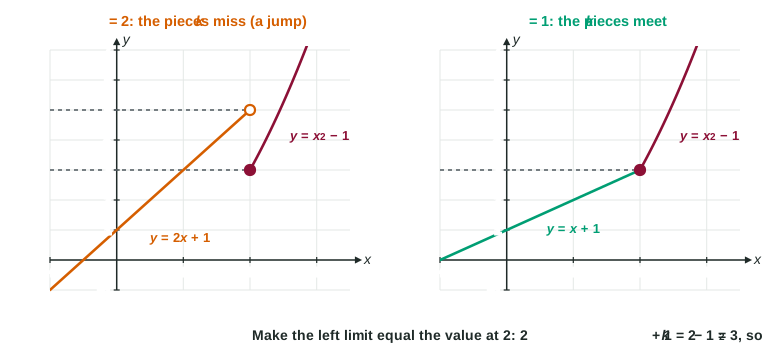
Worked example 2. Let for and for . Find so that is continuous at 2.
Left:
Right and value:
Set them equal: , so .
Check: with the left side approaches , which matches.
Each piece here is a polynomial, continuous on its own interval, so the break point is the only place to check. With , is continuous on .
Two constants, two break points
A function with three pieces has two break points. Each one gives an equation, and together they fix two constants.
Worked example 3. for , for , and for . Find and so that is continuous everywhere.
At : the left side approaches ; the middle rule gives . So .
At : the middle rule gives ; the right side approaches . So , and .
When no value works
A constant can only move its own piece. Suppose for , , and for . The right side approaches 7, but the value is fixed at 5. No choice of changes either of those, so no makes continuous at 3. Always compare all three: left limit, right limit and value.
Jumps and infinite discontinuities cannot be removed either. At a jump the one-sided limits disagree, so there is no single limit for the value to match. Near a vertical asymptote the function is unbounded, so again there is no limit. Only removable discontinuities live up to their name.
Writing it up
A complete answer names the condition and shows the numbers: "For to be continuous at 2,