Removing a Discontinuity
A removable discontinuity is removed by defining f(c) to be the limit at c .
Part 1 · Hook
Why this matters
Part 2 · Before you start
What this builds on
Part 3 · Prerequisite check
Quick check before you start
1. is continuous at when
- exists, the limit at exists, and they are equal
- the graph looks smooth
- exists
- the one-sided limits exist
Show the answer
All three conditions are needed.
- Correct: exists, the limit at exists, and they are equal:
- the graph looks smooth:
- exists:
- the one-sided limits exist:
2. is
- 2
- 1
- 0
Show the answer
- Correct: 2:
- 1:
- 0:
- :
3. At a removable discontinuity, the limit
- exists
- does not exist
- is unbounded
- equals the function value
Show the answer
Removable: the limit exists but the value is missing or different.
- Correct: exists:
- does not exist:
- is unbounded:
- equals the function value:
Part 4 · See it
See it first
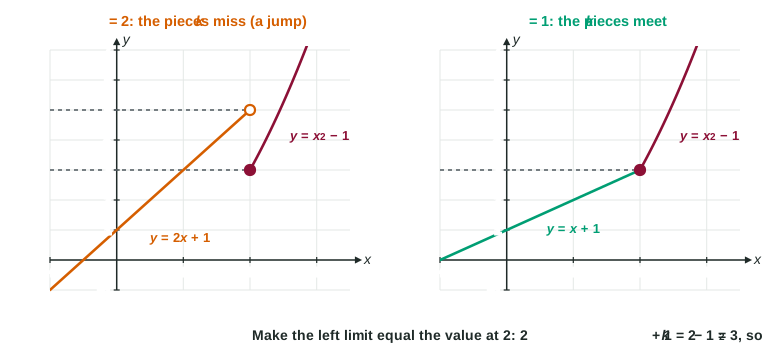
Part 5 · Step by step
How it works, step by step
- has a removable discontinuity at , with defining (or redefining) makes continuous at
- A piecewise function has a constant in one or both piecescontinuity at the break point gives an equation: the left-hand limit equals the right-hand limit equals the value
- There are two unknown constants and two break pointseach break point gives one equation; solve them together
- The discontinuity is a jump or infiniteno single value can fix it, because the two-sided limit does not exist
Part 6 · Key ideas
Key ideas
- To remove a removable discontinuity, find and define .
- At a break point of a piecewise function, set the left-hand limit, the right-hand limit and the value equal. Each break point gives one equation.
- A constant can only move its own piece. If the value at the point and the other piece already disagree, no constant fixes it.
- A jump or an infinite discontinuity cannot be removed: the limit does not exist, so no value can equal it.
- Write the result as a check: substitute your constant back and show both sides give the same number.
Part 7 · Misconception
A common mistake
The wrong idea: To make continuous at , just define to be any number, since the problem is that is undefined.
What actually happens: The value must equal the limit:
Part 8 · Check yourself
Check yourself
Exam-style questions. Anything you miss goes into your review queue.
Table
A piecewise function with a constant
| Where | Rule for |
|---|---|
1. Find the value of that makes continuous at .
No calculator. Type the exact value (a fraction, π, e or a root is fine).
Show the answer
Continuity at 2 needs
- Answer: ≈ 2.333
2. Why is the equation the right condition for continuity at ?
- It sets the left-hand limit equal to the right-hand limit and
- It makes defined, which is the condition that was failing at
- It makes both rules give 0 at , so has a zero there and no break
- It sets the two rules equal at each , so that the pieces become one rule
Show the answer
is from the left rule. The right rule gives both and , namely . Setting them equal makes the limit exist and equal .
- Correct: It sets the left-hand limit equal to the right-hand limit and : One equation covers all three conditions, because the value at 2 comes from the right rule.
- It makes defined, which is the condition that was failing at : is defined for every .
- It makes both rules give 0 at , so has a zero there and no break: Nothing needs to be 0; the two sides just need to match.
- It sets the two rules equal at each , so that the pieces become one rule: The rules are compared only at , where the pieces meet.
3. If , what happens at ?
- A removable discontinuity, a hole at height 1
- A jump; the sides approach 1 and 5
- An infinite discontinuity at
- Nothing; is continuous at
Show the answer
With :
- A removable discontinuity, a hole at height 1: A removable discontinuity needs the two sides to agree; here they are 1 and 5.
- Correct: A jump; the sides approach 1 and 5: Left rule , right rule : they differ.
- An infinite discontinuity at : Both rules are polynomials, so nothing is unbounded.
- Nothing; is continuous at : Only makes the pieces meet.
Table
Four functions, each undefined at one point
| Function | Formula | Undefined at |
|---|---|---|
4. What value should be given so that is continuous at ?
No calculator. Type the exact value (a fraction, π, e or a root is fine).
Show the answer
Multiply by the conjugate:
- Answer: ≈ 0.167
5. Which discontinuity can be removed by defining or changing a single value of the function?
- at
- at
- at
- at
Show the answer
A single value can fix a discontinuity only when the limit exists. near 1, so its limit is 2; defining the value 2 there removes the break.
- at : The one-sided limits are and : a jump. No single value makes them agree.
- at : It is unbounded near 1; no value can fix that.
- Correct: at : The limit exists (2), so the hole can be filled.
- at : It is unbounded near 1; no value can fix that.
6. Let for , , and for . Which value of makes continuous at ?
- , so the left side approaches 7, like the right side
- No value of ; the right side approaches 7, but
- , so the left side approaches
- , the difference between 7 and
Show the answer
Continuity needs the left limit, the right limit and all equal. The right limit is , which differs from whatever is. So no works.
- , so the left side approaches 7, like the right side: The limit would then be 7, but , so the third condition fails.
- Correct: No value of ; the right side approaches 7, but : only moves the left piece; the mismatch between 7 and 5 stays.
- , so the left side approaches : The left side would approach 5, but the right side approaches 7: a jump.
- , the difference between 7 and : Subtracting values does not fix a mismatch between the right side and .
Part 9 · Summary
Summary
Part 10 · Up next
What comes next
Part 11 · Connections